Concept

XYZ — where it appears

The CIE's tristimulus space, in which every colour is three integrals of a spectrum against three fixed functions. It is deliberately not perceptual: equal steps in it do not look equally different, which is what the spaces built on top of it exist to repair.

Named by 11 essays across 6 fields — each of them below, with the objects they name alongside it.

The CIE 1931 colour-matching functions. The three functions that turn a spectrum into three numbers. They are all positive, which is why XYZ exists — the RGB functions they were derived from are not. ȳ is by construction the luminous efficiency function, which is why luminance comes out of Y.

Seventeen observers in 1931

The standard observer that governs every colour specification in industrial use is an average over seventeen young British men, measured with equipment from the 1920s. It is known to be wrong in the blue, the correction has existed since 1951, and it has never been adopted.

limits · Limits
Two identical grey patches on different surrounds. Both inner squares are #868686. The one on the dark field looks lighter. The values are checked to be equal before the figure is drawn, so the claim is a fact about the drawing rather than a promise.

Matching is not appearance

CIE XYZ predicts when two lights will look the same under identical viewing conditions. It was never a model of how anything looks, and most of the confusion in applied colour comes from using it as one.

matching · Gamut
The CIE 1931 colour-matching functions. The three functions that turn a spectrum into three numbers. They are all positive, which is why XYZ exists — the RGB functions they were derived from are not. ȳ is by construction the luminous efficiency function, which is why luminance comes out of Y.

Why colour is exactly three-dimensional

Matching every wavelength with three primaries requires, for some wavelengths, a negative amount of one of them. That physical awkwardness is why the colour-matching functions were transformed into XYZ, and why the horseshoe is curved.

eye · Cones
The sRGB transfer function, and the gamma 2.2 curve it is not. Code value against relative luminance. The sRGB function is piecewise — a short linear segment near black, then a 2.4 power law with an offset — and it is close to but not the same as a plain 2.2 power law. Half-way along the axis of stored values sits at 21 per cent luminance, and half the luminance of white is at code 188.

A hex code is not a colour

Six hexadecimal digits identify three numbers. Turning three numbers into a colour needs a colour space, a transfer function, a white point and a display, and leaving any of them unstated is the everyday version of every confusion in colour management.

matching · Gamut
Four adaptation transforms, measured against CAT16 (D65 to D50). Twenty-seven colours moved from D65 to D50 by each transform, compared with the current recommendation. Bars are the worst disagreement in CIELAB, the number beside each is the mean. Plain XYZ scaling — still shipping, still called von Kries by people who have not read von Kries — misses by up to ΔE 13.7, which is many times any tolerance a supplier would be held to.

Four ways to move a white point

Every chromatic adaptation transform is the same three lines with a different matrix. The matrices disagree by more than any tolerance a supplier is held to, and the oldest one — still shipping, still called von Kries — is not a cone basis at all.

brain · Appearance
How far a match comes apart when the observer changes. A broad source and a three-primary source, solved at each primary width so the pair is an exact tristimulus match for the CIE 1931 observer. The pair is then handed to the 1964 observer, and the gap between them is plotted. For the observer they were built for the gap is arithmetic noise at every width. For the other it grows as the primaries narrow, reaching 0.012 at 10 nm — and displays have been getting narrower for twenty years.

Two degrees or ten

This site names the observer on every figure it draws, which was supposed to be the point. Measuring what it had actually done found two hundred and four figures naming the same observer, three naming the other, and sixty-two of sixty-four generators printing a string that had never once varied.
limits · Limits
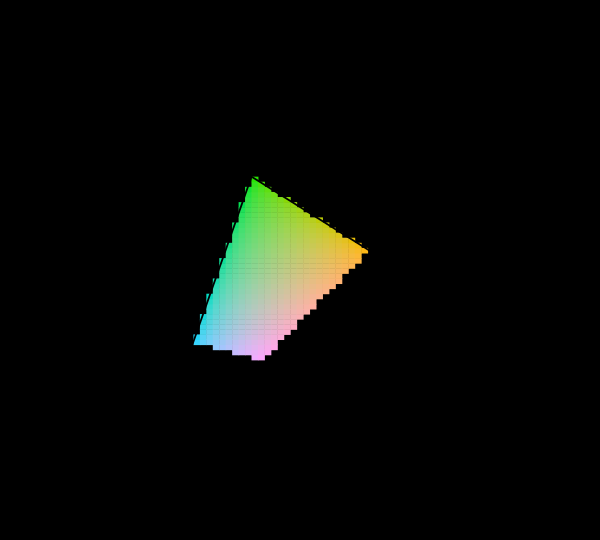
sRGB, Display P3 and Rec. 2020 compared on the chromaticity diagram. Three nested triangles inside the horseshoe. sRGB covers 74 per cent of the area P3 covers. Rec. 2020's red and green primaries sit on the spectral locus itself, within 0.000 and 0.006 of it, meaning they are monochromatic.

Six numbers make a space

An RGB colour space is eight numbers — three primary chromaticities, a white point, and a transfer function — and everything else about it is derived. Deriving it rather than copying the matrix is the difference between having a colour space and having a table somebody else computed.

matching · Gamut
A camera's spectral sensitivities, after the infrared-cut filter. Silicon quantum efficiency times the colour-filter dye times the infrared-cut filter, per channel, on a grid running to 1100 nm rather than to 780. With the filter removed, 68 per cent of the area under the three curves lies beyond the visible band, and all three curves are the same curve out there.

A camera is a fourth observer

The 1931 functions, the 1964 functions and a person's own cones are three sets of three curves that collapse a spectrum onto three numbers. A camera is a fourth, built from silicon and dye rather than from pigment and neural wiring, and it agrees with none of them.

imaging · Capture
A silicon sensor's best possible impersonation of the standard observer. The 1931 matching functions in outline, and the closest linear combination of the sensor's three sensitivities laid over them; underneath, what is left over at each wavelength. The residual is 31.7 per cent of the matching functions' own magnitude, worst at 440 nm. Colour reproduction is exact if and only if this is zero.

Luther said when it would work

There is an exact condition under which a fixed three-by-three matrix converts camera raw to XYZ correctly for every spectrum in existence. It was stated in 1927, it is a theorem rather than a guideline, and no camera ever built satisfies it.

imaging · Capture
One observer's matching functions, in three of the bases the matches leave free. The three colour-matching functions after a change of basis 0.00 of the way from Hunt–Pointer–Estévez towards the set built from the dichromat confusion points. Every one of these triples predicts exactly the same matches as every other, because a match is an equality and a matrix applied to both sides of an equality changes nothing. What moves is where the peaks are and whether the curves go negative — these ones do not, and going negative is what the 1931 committee constructed XYZ to avoid.

The matches do not name the cones

Colour matching is the whole empirical basis of colorimetry, and it fixes the observer's three curves only up to a nonsingular 3×3 — nine numbers that no match, in any quantity, to any precision, can see. One particular choice of those nine is used throughout here, and it was made for a different purpose.

eye · Cones
The same formula, applied after six different changes of basis. CIELAB's arithmetic — divide by a white, take a cube root, difference the results — run on six of the bases the matching data leave free. A linear change of basis leaves every match alone; a cube root does not commute with one, so the space, and therefore every colour difference computed in it, depends on which basis was in place before the nonlinearity. CIELAB's own choice gives an axis ratio of 3.44 and the best row here is LMS (confusion points) at 2.60.

A difference needs a basis too

A linear change of coordinates leaves every colour match exactly where it was. A cube root does not commute with one — so a lightness–chroma space, and every colour difference computed in it, is a property of the basis that happened to be in place before the nonlinearity. CIELAB's basis was chosen in 1931 for reasons that had nothing to do with difference.

difference · Metric

Named alongside it

The objects these essays reach for when they reach for this one.

Standard observerWhite pointColour-matching functionsCone fundamentalsPrimariesColour managementColour spaceGamutAdaptationCamera rawCIECAM16ΔE

All concepts