A thin dot edge lets the glow back in
Assumes Adapting to a brightened sheet leaves the glow, Some paper is brighter than white and Newsprint turns a tint with its colour, not its gain.
Office paper, most book paper and much coated stock carry an optical brightener, a dye that absorbs ultraviolet and emits blue, so that under a lamp with ultraviolet in it the sheet returns more blue than falls on it. Some paper is brighter than white is the collection’s account of why such a sheet has no reflectance curve, and adapting to a brightened sheet leaves the glow followed what the glow does to a printed tint. A pale tint on such a sheet is mostly bare paper, and so mostly glow; the ink’s vehicle, the resin its pigment sits in, absorbs the ultraviolet on its way in, so paper under a solid glows at about a seventh of the rate. For a reader who did not adapt to the sheet, a fifth-coverage orange turned 41.5 degrees of hue from its solid, the coated way and five times as far as on a coated sheet — where newsprint turns a tint with its colour had found the same tint turning the other way on a yellow sheet.
The part that mattered came after adaptation. A sheet dyed to exactly the brightened sheet’s colour, without fluorescing, lost almost all of its turn to a reader fully adapted to it: 3.2 degrees were left, within a degree and a half of a plain white sheet. The brightened sheet itself left ten. On newsprint, a reader sees the reversal until almost adapted had found the paper’s colour vanishing entirely once adaptation was complete; the brightener’s share does not. The difference, 6.8 degrees on the orange and 8.9 on the red, is the brightener’s, and it survives adaptation because it is not a colour of the white. Adapting to a white rescales light; the glow is light that the tint has and the solid lacks, and no rescaling removes a difference of that kind.
That census gave every dot the same film thickness from centre to edge. A real dot is not like that. The ink is carried onto the paper as a film that thins towards the dot’s edge, and at the edge the film is a fraction of its thickness at the centre. The closing section of the earlier essay noted three things together: a thin film lets more ultraviolet through, most of a small dot is edge, and a pale tint is made of small dots. The prediction was that the edge restores the glow under a pale tint’s dots, so that the residue after adaptation falls by about a third at a fifth coverage while the solid, a continuous film with no edge, keeps none of the glow — and the residue would then grow towards the middle of the ramp, making the mid-tone the proof a designer should look at.
The edge lets the glow in, and the residue grows
A thin dot edge restores the glow, as predicted: under a five-per-cent orange dot with a twelve-micrometre rim, a quarter of the bare paper’s glow reaches the eye where a uniform film let three per cent through. But the residue a fully adapted reader still sees grows with the rim instead of shrinking — at a fifth coverage from 6.8 degrees with a uniform film to 7.1, 7.4 and 7.9 with rims of three, six and twelve micrometres, and at a twentieth coverage from 7.2 to 9.0. It grows for every one of eight inks at every coverage, and with or without a rim it is largest at the palest tint and falls steadily towards the middle of the ramp. The prediction’s direction was wrong, and so was its advice about which tint to proof.
- The prediction is right about the mechanism. A rim lets ultraviolet in and the glow out, and it is most of a small dot.
- It is wrong about what the extra glow does. The residue is the glow the tint has and the solid lacks; glow let back under the tint’s dots is more of that difference, not less.
- It is wrong about the ramp. The palest tint, mostly bare paper, keeps the most residue whatever the dots are like, and the rim adds most there.
- The size is modest. Even a twelve-micrometre rim moves the residue by a degree or two; it changes the argument’s sign, not its scale.

Each curve is one kind of dot, and every one falls from left to right: the residue is largest at five per cent coverage and smallest at sixty. The uniform film’s curve is the earlier census’s, 7.2 degrees at the pale end and 5.1 at sixty per cent. Each wider rim lifts the whole curve, and lifts its left end most. The prediction had the curves crossing — a rim pulling the pale end down below the mid-tones — and they never come near it.
What a dot’s edge is

On a 150-line screen the halftone cell is 169 micrometres square, and a round dot of coverage has a radius of micrometres: 21 at five per cent, 43 at twenty, 67 at fifty. The census gives each dot a film at the solid’s thickness over its interior, falling linearly to nothing over a rim at its edge, and runs rims of three, six and twelve micrometres. Twelve micrometres is most of a pale dot and a third of a mid-tone one: 81 per cent of a five-per-cent dot’s area lies in its rim, 48 per cent of a twenty’s and 32 per cent of a fifty’s. A three-micrometre rim is a quarter of the palest dot and a tenth of the mid-tone.
What a real rim is depends on the process. An offset dot is squeezed onto the paper from a plate and a blanket, and its film thins over a few micrometres at the edge; a dot that gains — spreads on press, as a dot is larger than it was asked to be measured — gains a thin fringe of exactly this kind. The census does not claim to know a press’s rim. It brackets it, from none to twelve micrometres, and asks what each does.
How much ultraviolet a thin film lets through

The ink’s vehicle absorbs in the near ultraviolet with an absorbance of 1.35 at the short end, falling away through the violet; weighted by the photons the brightener would have absorbed, a full film lets 13.5 per cent of the excitation through. Beer–Lambert makes a thinner film exponentially clearer: half a film lets through 34 per cent and a tenth of a film 79. The glow the brightener then emits under the dot must come back out through the same film, and the pigment filters it on the way — for the orange, which absorbs the brightener’s blue strongly, that return trip costs most of it at full thickness and little at the rim.

Averaged over a dot’s area, the two passes together let 2.9 per cent of the bare paper’s glow through an orange dot with a uniform film, at every coverage. A rim changes that sharply and unevenly. A twelve-micrometre rim lets through 26 per cent under a five-per-cent dot, where it is most of the dot, and 10 per cent under a sixty, where it is a third; a three-micrometre rim 9 and 5. The glow under a pale tint’s dots is nine times what the uniform census allowed. That half of the prediction is right, and by more than it needed.
Why more glow under the dots is more residue
The prediction reasoned that the residue came from the ink putting out the glow, so that letting the glow back in would remove it. That reverses what the residue is. The residue is a difference between the tint and its solid: the tint’s hue is measured against the solid’s, the solid is a continuous film that glows at 2.9 per cent of bare paper with or without rims, and the tint glows at whatever its bare paper and its dots together give. Adaptation can divide out the sheet’s colour because the sheet’s colour is a common factor of the tint and the solid. It cannot divide out light that one has and the other lacks, and that is exactly what the glow is.
A rim adds glow to the tint and nothing to the solid. It widens the difference that adaptation cannot remove. At a fifth coverage the orange tint, fully adapted, turns 11.1 degrees from its solid with a twelve-micrometre rim where it turned 10.0 with a uniform film; the dyed sheet’s 3.2 is unchanged, because a sheet that does not fluoresce has no glow for a rim to let through. The residue — the brightener’s share — goes from 6.8 to 7.9.
The same arithmetic explains why the palest tint keeps the most, rim or no rim. A pale tint is mostly bare paper, and bare paper is where the glow is; the more of a tint’s light is glow, the further its hue is pulled from the solid’s by light the solid does not have. At sixty per cent coverage four tenths of the tint is paper, at five per cent nineteen twentieths. The residue is the paper’s share of the tint, glowing — and a rim, which is most of a small dot, adds most where the paper’s share is already largest.
Eight inks

Every ink’s residue grows with the rim, at every coverage, and every ink keeps the most at its palest tint. The inks that absorb the brightener’s blue most strongly — the red, the orange — have the largest residues to begin with, because on those a glow the solid lacks is most unlike the solid’s own colour: the red’s goes from 9.3 degrees to 11.4 at five per cent coverage, the largest change of the eight. The cyan’s, which starts small because a cyan ink passes blue, grows by the largest share — from 2.4 degrees to 4.3, eight tenths again — because a thin cyan film passes both the ultraviolet in and the blue glow out. The blue, violet and yellow inks move least. None moves the other way.
What a designer should proof
The palest tint, not the mid-tone. The earlier essay’s advice, drawn from the prediction, was that a designer checking a brightened stock should look at a mid-tone. With a uniform film or with any rim here, the hue turn a reader cannot adapt away is largest at the palest tint and falls towards the middle of the ramp. A proof of a colour on brightened paper should include its lightest tints — the highlights of a photograph, the pale panels of a layout — because that is where the sheet’s glow sets the colour most.
Expect the press to be worse than the model. A uniform ink film is the model’s idealisation, and every real dot has some edge. The census’s rims move the residue in one direction only, so a prediction made with uniform films is an underestimate of what a reader will see on a real print. A proof cannot glow found a proofer unable to reproduce a brightened sheet at all; a proof that tries is aiming at a target that its own model has set too low.
A halftone is not a mixture here either. A halftone is not a mixture insisted that a tint is a mosaic of inked and bare areas, not a blend. The glow adds a third kind of area — the rim, which is inked and glowing at once — and its share of the mosaic depends on the dot’s size, not only on the coverage. Two tints of equal coverage printed with different dot sizes glow differently.
Say which light the measurement used. Every number here is for daylight with its ultraviolet, the light a reader by a window sees a print in. An instrument brings its own light found that the four measurement conditions a spectrophotometer can be set to are four different quantities on a brightened sheet, and only the one with daylight’s ultraviolet in it sees the glow at all. A tint measured under a condition without ultraviolet shows no residue and no rim effect, and a colour specification checked that way has checked a sheet nobody will read the print on. Under a lamp with no ultraviolet the earlier census found the orange tint’s whole turn falling to 1.7 degrees, and the rims here change nothing there, because there is nothing for them to let through.
The size of the rim is a property of the press, and nobody quotes it. A printer states a dot gain, a total ink limit and a screen ruling; none of these says how thin a dot is at its edge. The census brackets the rim from nought to twelve micrometres because that is the range over which it moves the residue by a degree or two; a press whose dots carry a wide fringe of thin ink — a soft blanket, a heavily gaining uncoated stock — sits at the top of that range, and its pale tints on brightened paper turn furthest from their solids for the reader who has adapted to everything else.
How the dots were modelled
The sheets, inks, tints and reader are the earlier census’s: office paper with a brightener loading of 0.8 under daylight reconstructed to 300 nanometres, eight inks, the tint’s reflected light through a Yule–Nielsen halftone model with the uncoated sheet’s factor of three, and a reader adapted by Bradford a share D of the way from daylight’s white to the sheet’s, reading hue in Oklab. The only change is the glow under a dot. Each dot of a 150-line screen is round, with radius micrometres, and its film has relative thickness one inside its rim and falls linearly to nought across a rim of w micrometres. At each radius the vehicle passes 10^(−1.35·t) of the ultraviolet at the short end, per wavelength and weighted by the brightener’s absorption, and the pigment passes (R/0.9)^(t/2) of the glow on the way out; the glow under a dot is these averaged over its area in 240 rings. The solid is a continuous film with no rim. With no rim, every tint’s turn at every coverage and degree of adaptation is the earlier census’s exactly, which is checked. The residue is the fully adapted reader’s turn on the real sheet less the turn on the sheet dyed to its colour.
What the model leaves out
The rim thins the pigment too. A thin edge carries less pigment, so it also reflects more light and changes the tint’s reflected colour. The census leaves the reflected half as the earlier census had it — through a halftone model whose dot gain was fitted to real prints, and which therefore already includes whatever real rims do to reflection — and changes only the glow.
Round dots, one ruling. Real screens use elliptical and square dots whose perimeters differ from a circle’s, and finer rulings make every dot smaller and so more rim. Stochastic screens, which print the palest tints as scattered dots of one small size, are the extreme case.
A linear rim. The film’s profile across the rim is a straight line from full to nothing. A real profile is rounded, and a rim that falls off steeply near its outer edge would let through less than a linear one of the same width.
Still open: whether a finer screen glows more
The rim adds most where it is most of the dot, and a dot’s size at a given coverage is set by the screen’s ruling. A 200-line screen makes every dot three quarters the width of a 150-line dot; a stochastic screen prints a pale tint as a scatter of dots twenty micrometres across, all of them mostly rim.
The calculation is this census across rulings — 100, 150, 200 and 300 lines, and a stochastic screen of fixed twenty-micrometre dots — with the rim held at six micrometres. The prediction is that the residue rises with the ruling at every coverage, and that the stochastic screen, whose dots are the same size at every coverage, holds its residue nearly flat across the pale half of the ramp at the level a 300-line screen reaches only at five per cent — so that switching a job from conventional to stochastic screening on brightened stock turns its pale tints by a degree or two further, and no adaptation of the reader takes it back.
A difference is not an amount
The habit here is about what a correction is correcting.
The prediction treated the residue as an amount of glow blocked by the ink, and reasoned that letting the glow through would reduce it. The residue was never an amount. It was a difference between two patches, one of which gains glow from a thin edge and one of which does not, and anything that adds to one side widens it.
The failure mode is to reason about a difference as though it were one of its terms. The test is to write the quantity down as what it is — here, the tint’s hue less its solid’s, after adaptation — and ask of any change which side it acts on.
Where this goes next
 Adapting to a brightened sheet leaves the glow
A pale tint on newsprint turns its hue one way and on coated paper the other, and a reader fully adapted to the paper sees newsprint's reversal vanish, because it was only the paper's colour. On a sheet with an optical brightener the tint turns the coated way and five times as far — 41.5 degrees for a fifth-coverage orange. A reader adapted to the sheet removes most of that, as expected, but not all: ten degrees stay. The sheet's colour adapts away like newsprint's. The brightener's glow does not, because the ink puts it out under the solid and leaves it under the tint, and an added light is not something adapting to a white can divide out.
 Some paper is brighter than white
The reflectance model assumes light leaving at a wavelength arrived at that wavelength. A fluorescent sample breaks the assumption, has no reflectance curve at all, and is in almost every sheet of white paper sold.
 A halftone is not a mixture
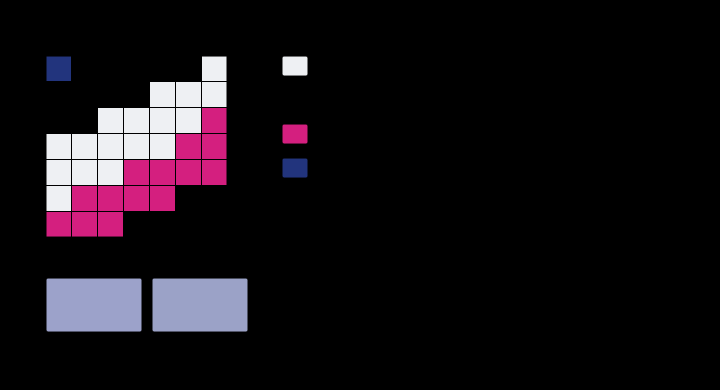
Forty per cent cyan and thirty per cent magenta are not stirred together anywhere. They are laid down as dots, and the sheet is a mosaic of four fully-inked regions in proportions the two coverages fix — which is why the colour is an area average of four spectra rather than a blend of two, and why it lands nowhere near where mixing would put it.
What this makes readable
Essays that name this one as a prerequisite.
Named alongside this one
Essays reaching for the same objects. Nobody chose these; they are what the index of named objects makes visible.
- An ink for a fading sheet is set for its middle age chromatic adaptation · fluorescence · halftone · hue · optical brighteners
- The glow alone sets the light ink chromatic adaptation · fluorescence · halftone · hue · optical brighteners
- The glow's colour sets the blue ink and spares the orange chromatic adaptation · fluorescence · halftone · hue · optical brighteners
- The glow's pull on the white sets every ink chromatic adaptation · fluorescence · halftone · hue · optical brighteners
- A camera cannot record the excitation fluorescence · optical brighteners · ultraviolet
- A reflectance is a diagonal fluorescence · optical brighteners · ultraviolet
What links here
Every essay whose body links to this one.
- Merged spots give the mid-tones half the glow back
- Stochastic dots hold the glow at every tint
- A yellowing base leaves the ink where the glow put it
- One light ink serves three papers within two degrees
- A light ink can cancel the glow at one strength
- A growing clump prints like the screen with as many dots
- Squares of four print a pale tint like a 150-line screen
- The rim was never most of the glow
The objects this essay names
Each one links to every other essay that touches it.
Chromatic adaptationFluorescenceHalftoneHueModelling assumptionOptical brightenersUltraviolet