Concept

Transmittance — where it appears

The fraction of light passing through a material at each wavelength, which is what a filter, an ink film or a sheet of glass is described by. Transmittances multiply where absorbances add, which is the whole content of the Beer-Lambert law.

Named by 10 essays across 4 fields — each of them below, with the objects they name alongside it.

The same medium at six path lengths. Beer's law at 6 depths of one absorbing medium. The absorption coefficient is a single spectrum and the only thing changing is how far the light travelled, yet the patches differ in hue by 7.8° as well as in lightness — because absorption is exponential in depth and the observer is linear, so the bands that survive at d = 8 are not a scaled copy of the ones that survive at d = 0.25. Path length belongs to the geometry, not to the substance, which is why this sits in a field about scenes.

The colour is in the thickness

Transmittance is exponential in path length and the observer is linear, so doubling the depth of an absorbing medium squares the transmittance rather than halving the colour. A translucent object therefore has no one colour — its thin edge and its thick middle are different spectra of the same substance, and the hue moves between them.

scene · Scene
The blue channel, as the three things multiplied to make it. Silicon's quantum efficiency, the colour-filter dye's transmittance, and their product. The dye is the only stage carrying any colour information and it is clear above about 800 nm — transmittance 0.92 at 900 nm against 0.06 at 550.

Silicon sees past the visible

A sensor's response ends at 1107 nanometres because that is the band gap, and the colour-filter dyes have stopped absorbing three hundred nanometres before it. So all three channels measure the same thing over the last third of the range, and every published sensitivity plot is drawn after the component that hides it.

imaging · Capture
How much of what an unfiltered sensor records is invisible. The share of a camera's raw signal coming from beyond 780 nm, against the colour temperature of the lamp, for one surface with a near-infrared reflectance of 0.62. Without the filter it runs from 98 per cent at 2000 K to 51 at 9000; with it, under five per cent everywhere.

The filter that makes colour possible

An infrared-cut filter is not a refinement on a colour camera. Removing it collapses the separation between the three channels by a factor of nearly nine under tungsten, and the component that keeps colour photography working is the one nobody photographs.
imaging · Capture
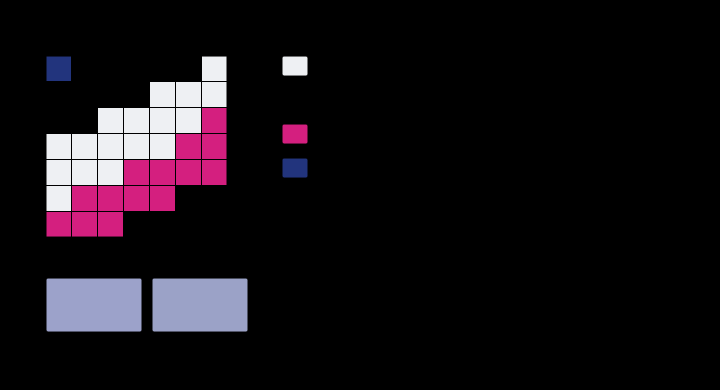
A halftone tint, its four regions, and what they average to. At 40% and 30% coverage the sheet is a mosaic of 4 fully-inked regions, not a mixture of anything. Their areas are the product of the coverages — Demichel's rule, which holds because the screens are rotated to make it hold — and the patch's reflectance is the area-weighted average of theirs, raised to the Yule–Nielsen exponent n = 1.8. Averaging the regions' CIELAB coordinates instead, which is what mixing means to almost everybody, lands ΔE00 = 0.76 away.

A halftone is not a mixture

Forty per cent cyan and thirty per cent magenta are not stirred together anywhere. They are laid down as dots, and the sheet is a mosaic of four fully-inked regions in proportions the two coverages fix — which is why the colour is an area average of four spectra rather than a blend of two, and why it lands nowhere near where mixing would put it.

applied · Delivery
A 2-nanometre notch, and what two five-nanometre grids record of it. The reflectance of a sample with a 2-nanometre notch at 552.3 nm, drawn finely from 535 to 570 nm. The dark ticks are the samples of a five-nanometre grid starting at 380 nm and the pale ticks those of the same grid started half a step later. The true minimum is 0.06; the first grid's deepest sample reads 0.70 and the second's 0.08. The sample has put a line into a calculation whose light has none.

The line can be in the sample

The rule for which tabulation defect to fix compares the light's narrowest feature with the grid's step, and it named its own failure case — a sample with structure narrower than the step. Given one, a two-nanometre notch under a thermal source with no feature at all costs 2.1 colour differences at five nanometres and moves 2.0 when the grid slides, which is what a fluorescent tube costs on a smooth pigment. Under that tube a notch twelve nanometres wide, more than twice the step, moves 8.1 when it sits on the mercury line.

light · Light
What a five-nanometre grid costs a steep-sided notch, against its width, under a 6500 K source. The cost of a five-nanometre grid starting at 380 nm, against a reference at two hundredths of a nanometre, for a sample with a flat-bottomed notch at 552.3 nm under a 6500 K thermal radiator, against the notch's width from 2 to 30 nm, for edges rising in 0.4, 2.2, 6.6 nm. With the steepest edges the cost is 0.02 at 10 nm, 1.99 at 12.5 and 0.03 at 20: it rises and falls with the step as its period and does not die away as the notch widens. With the softest edges it stays under 0.10 at every width.

The cost of a steep notch repeats every step

A Gaussian notch is safe on a five-nanometre grid once it is a couple of steps wide. A flat-bottomed notch with steep sides never is. Its cost on the grid rises and falls with its width, with the step as its period — 0.02 colour differences at ten nanometres, 1.99 at twelve and a half, 0.03 at twenty — and it does not die away as the notch widens. What sets its size is how fast the edges rise, and an interference filter's edges rise in under a nanometre.

light · Light
A 12-nanometre notch at 546.1 nm under a fluorescent tube, tabulated five ways. The cost against a tenth-nanometre reference, on a five-nanometre grid, of a notched sample under a fluorescent tube, mercury lines on a phosphor bed, when the two factors of the colour are tabulated as points, when the lamp alone is measured through a five-nanometre slit, when the sample alone is, when each is measured through its own slit, and when the light the sample reflects is measured through one slit. The costs are 2.535 for both sampled at points, 0.379 for the lamp through a slit, 2.724 for the sample through a slit, 0.727 for both through their own slits, 0.019 for the product through one slit. The tick on the two-slit bar is the same two tables summed at a tenth of a nanometre, 0.749: what the separate slits leave is not the grid's.

Two slits are not one slit

A spectrometer's slit is what makes a coarse table honest, for a lamp and for a notched sample alike. But a colour is a sum over the product of the two, and a notch measured through one slit and a lamp measured through another are not the product measured through a slit. Under a smooth light the difference is nothing. Under a fluorescent tube a notch on the mercury line comes out 0.73 colour differences off from two slits — worse than no slit at all for some notches — and 0.02 off from one slit on the reflected light.

light · Light
Six ways of tabulating one notch on one mercury line. A 12-nanometre notch centred on a fluorescent tube's 546.1 nm line, its colour computed on a five-nanometre grid six ways, on a logarithmic scale. Point sampling costs 2.54 colour differences and two separate slits 0.727. Sharpening both blurred tables with the published three-term correction takes it to 0.188 — a real improvement, four times better — and one slit on the light the sample actually reflects gives 0.019. The correction recovers the part of the damage that is a blur, and the part that is left is not a blur.

A linear repair for a bilinear loss

The Stearns correction sharpens a table blurred by a triangular slit, and the obvious question was whether applying it to a lamp's table and a sample's restores the product the two of them are wrong about. It restores four fifths of the damage and cannot touch the rest: a three-term filter is linear, the covariance two separately blurred tables discard is bilinear in the two factors, and no linear operator applied to each factor separately produces a bilinear term. What is left is ten times the one-slit answer, at every position of the notch.

light · Light
One instrument, one slit, two requirements. The slit's width swept, with three measurements on a logarithmic scale: a smooth sample under the line lamp, where only the lamp's structure is at stake; the notched sample under a smooth lamp, where only the notch is; and the real case, both at once. The lamp wants a slit of 5 nanometres and the sample wants 1, and each wants what it wants for the same reason: a slit should spread a feature the grid cannot resolve and leave one it can. The real case is best at 3 nanometres — which is neither requirement's answer — and costs 0.247 there, an order of magnitude more than either requirement alone.

One slit, two requirements

A line lamp wants a wide slit, because a wide slit spreads a line where a coarse grid can see it. A notched sample wants a narrow one, because a wide slit fills the notch the grid could have resolved. An instrument has one slit. Measured on the two requirements separately the best widths are five nanometres and one; measured on the two together the best is three, which is neither — and it costs twelve times what the lamp alone would cost and thirty-four times what the sample alone would.

light · Light
An interference notch filter, and where a five-nanometre grid lands on it. The transmittance of a Fabry-Pérot etalon of order 24 and finesse 20, drawn at a fifth of a nanometre, with the standard grid's points marked. Its features are 2.29 nanometres wide and spaced 22.9 apart, so the grid steps over them: between two adjacent grid points the transmittance rises and falls completely, and neither point records it. That is what a real coating looks like, and a Gaussian notch — which is what this collection's earlier work used — is a much gentler object.

A finer table is a worse table

A real interference filter is not a Gaussian notch. It is an etalon, with pass bands a nanometre or two wide spaced twenty-three apart, and a five-nanometre grid steps over them. Resampled from the maker's one-nanometre table its colour is out by five colour differences under every fill-in rule — the three rules agree to three decimals, because none of them is ever handed a sample inside a feature. The same filter measured through a five-nanometre slit is out by 0.03.

light · Light

Named alongside it

The objects these essays reach for when they reach for this one.

Spectral structureWavelength gridAliasingBandpassFluorescentInstrumentReflectanceSpectrophotometryIntegrationMeasurement conditionAbsorptionCamera raw

All concepts