Concept

Gradient — where it appears

The vector of first derivatives of a function with respect to its parameters, pointing the way it increases fastest. It vanishes at an optimum, which is why the *other* objective's gradient at one objective's optimum is what makes an exchange between two goals possible at all.

Named by 11 essays across 4 fields — each of them below, with the objects they name alongside it.
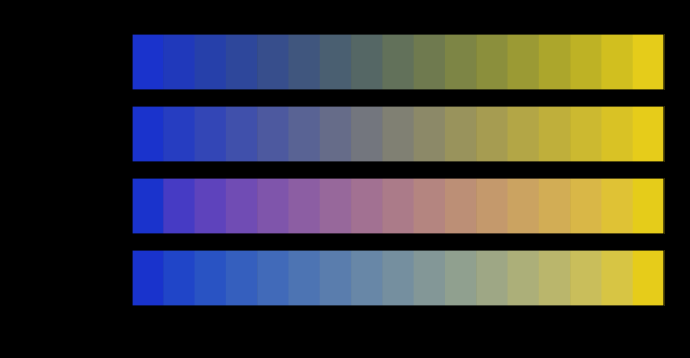
One pair of colours, blended in four spaces. Every row starts and ends at the same two colours and visits different ones in between. The chroma of the middle falls furthest in linear light, by 83 units below the straight line between the endpoints' chromas — the grey dead zone that every blue-to-yellow gradient has and that no endpoint mentions. Any colour a route visits that this display cannot show is hatched rather than clipped.

A gradient is a path

Two colours fix the ends of a blend and nothing else. The middle is decided by the space the interpolation happens in, and four spaces in daily use put the halfway point of one ordinary gradient as much as thirty-seven units of colour difference apart.

matching · Gamut
The cheapest direction to give ground in is the flattest one. Six bars, one per direction the adaptation objective can see, showing how much of the other objective a fixed budget of adaptation buys if it is spent along that direction. The rate is the slope of the second objective divided by the square root of the first's curvature, so it rewards a direction the second objective wants and punishes one the first is stiff in. The flattest direction wins at 10.68 against 3.29 for the next best and 0.54 for the stiffest — a factor of 20. Spending 1 per cent of the adaptation optimum there moves the anisotropy from 7.70 to 5.02.

The trade only runs one way

Standing at the basis that adapts best, one per cent of adaptation buys forty-four per cent of the way to the discrimination floor. Standing at the basis that discriminates best, the same one per cent buys under two. The scatter that shows two objectives pulling apart looks symmetric and is not, and the asymmetry is what a committee choosing between them would most want to know.

brain · Appearance
Two primaries mixed, and the line a reader assumes they take. The additive mixture of two sRGB primaries, walked in twenty steps, plotted in the a and b of CIELAB. The filled points are where the light actually goes, which is exactly straight in tristimulus values because that is Grassmann's second law. The open points are the straight line between the two readings. They part company by 26.7 ΔE₀₀ at their furthest, at 60 per cent of the way along, and the half-and-half mixture misses the midpoint by 21.1.

The mixture line bows

Grassmann's second law says an additive mixture is exactly linear in tristimulus values, and tested here it is exact to floating point. Nothing downstream of the three numbers preserves it. The physical half-and-half mixture of two colours sits a median of 5.5 colour differences from the midpoint of their two readings and up to thirty; on a green and a blue display primary it is twenty-one, which is a quarter of the distance between them.

matching · Gamut
Four mixtures of display primaries, bowing by different amounts in two units. The half-and-half mixture of each pair of sRGB primaries, measured from the midpoint of the two readings as a share of the pair's own separation. The upper bar is ΔE₀₀ and the lower is the appearance model's J′a′b′. In ΔE₀₀ green and blue bows most, at 25 per cent; in the model it is red and blue, at 20, and blue and yellow falls from 22 to 12. The right-hand column gives the model's distance with its power correction, which is smaller than the Euclidean one for every pair here.

Which mixture bows most depends on the ruler

The physical half-and-half mixture of two lights misses the midpoint of their two readings in any unit a person is shown, and the share it misses by is about the same in ΔE₀₀ and in the appearance model's own space — 12.8 and 14.6 per cent at the median. Which mixtures miss most is not. The rank correlation between the two units is 0.57, a display's blue and yellow is the worst pair in one and the mildest in the other, and the smaller number usually quoted for the appearance model is its power correction rather than a straighter line.

matching · Gamut
The length of one grey ramp, cut into more and more steps. A neutral ramp from L 1 to L 100 cut into between one and ten thousand equal steps, each step measured and the steps added, in four units, both axes logarithmic. ΔE*ab and the model's Euclidean J′a′b′ give the same length at every step count, 99 and 96. ΔE₀₀ settles at 74.6 once the steps are small. The power-corrected ΔE′ does not settle: 25 in one step, 137 in a hundred, 755 in ten thousand, growing as the number of steps to the power 0.37.

A distance raised to a power has no length

CAM16-UCS's colour difference is its Euclidean distance raised to the power 0.63 and multiplied by 1.41. That is still a metric — the triangle inequality holds on every one of four thousand random triples — and it has no length. A grey ramp from black to white measures 25 units in one step, 137 in a hundred and 755 in ten thousand, growing as the number of steps to the power 0.37, and halving the size of a step triples the number of steps that fit.

difference · Metric
One edge magnified four times, three ways: text on a page. A step between the two colours of text on a page, magnified four times by linear interpolation, by bicubic and by a three-lobe Lanczos kernel, once on the stored values and once on the light. The curves are the stored-value result's lightness minus the light's, sample by sample across the edge; below the line the stored-value resize is darker. Linear interpolation is darker everywhere it differs. The two kernels with negative lobes swing above the line beside the edge, where their negative weights fall — bicubic by up to 1.8 colour differences and Lanczos by 3.7.

A resize with a negative weight in it

A blend taken on stored values is always darker than the blend of the light, because the encoding is concave and a convex combination of a concave function's values lies below the function of the combination. A bicubic or Lanczos resize is not a convex combination. Beside an edge its negative weights make the stored-value result lighter than the light's own — by up to 6.1 colour differences with bicubic and 12.2 with Lanczos on skin against its shadow — and on edges between full-scale values the clip hides the overshoot and the old guarantee appears to hold.
applied · Delivery
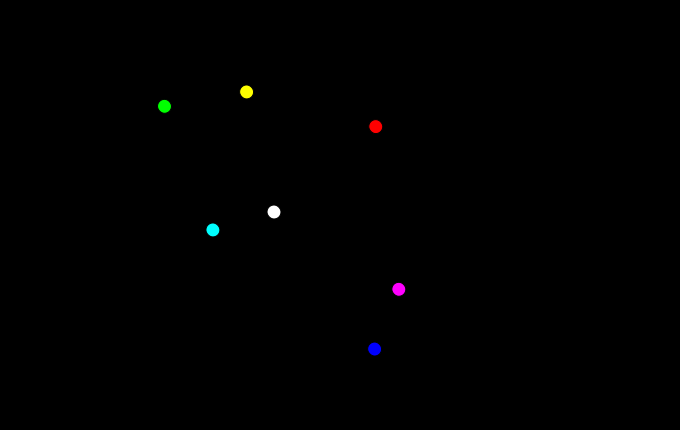
The straight line between two colours, and the formula's own shortest path. Five gradients seen from above, in the a and b plane of CIELAB: the straight line between the two colours in grey, and the shortest path under ΔE₀₀'s own local metric in colour. The lightness coordinate bows too and is not drawn. red to green saves 3.6 per cent and leaves the straight line by 13; blue to yellow saves 7.5 per cent and leaves the straight line by 21; cyan to magenta saves 3.9 per cent and leaves the straight line by 10; black to white saves 0.0 per cent and leaves the straight line by 0; red to blue saves 0.3 per cent and leaves the straight line by 4 CIELAB units at the widest. Black to white is the flat case: its shortest path is the straight one.

The straight line is not the shortest gradient

A colour difference formula says what a small step costs at every colour, and that is enough to ask which path between two colours is shortest. It is not the straight line: between red and green the shortest path bows thirteen CIELAB units away, saves four per cent — and stays inside sRGB on every step where the straight line leaves it. The formula's own answer for the two endpoints, meanwhile, is neither length.

matching · Gamut
Two uniform spaces, two answers: cyan to magenta. The gradient from above, in the a and b plane. The grey line is the straight path in CIELAB; the two coloured curves are the shortest paths under ΔE₀₀'s own local metric and under CAM16-UCS's. They are 15.7 CIELAB units apart at their furthest, against bows from the straight line of 9.9 and 12.2. Both spaces are published as uniform and both are used to decide what lies between two colours; they do not agree.

Two uniform spaces disagree about between

ΔE₀₀'s own local behaviour says which colours lie between two colours, and so does CAM16-UCS's. They do not agree. On cyan to magenta the two shortest paths run fifteen CIELAB units apart — more than either runs from the straight line — and on that gradient ΔE₀₀ would rather have the straight line than CAM16-UCS's answer. Getting the comparison at all takes noticing that one of the two has no local metric: its published difference is a Euclidean distance raised to the power 0.63, and a power below one has an infinite derivative at zero.

matching · Gamut
What a gamut charges a gradient, against what the relaxation's noise is. For each gradient, how much longer the best path that stays inside sRGB is than the free shortest path, as a percentage of the free one. The shaded band is the relaxation's own noise, measured by relaxing the same free path from two different starting points: 0.42 per cent at its worst. Every excess is inside it. So holding a gradient inside a display's gamut costs nothing measurable in the metric's own units, on any of these pairs — including the ones whose free path is outside at most of its points.

A gamut charges a gradient nothing

On red to green the shortest path happened to stay inside sRGB where the straight line did not, and that was called a coincidence of mechanism. Made into a measurement it is not a coincidence: constraining a path to stay inside the gamut costs less of the metric's own length than the relaxation's own noise, on every gradient tested — including the ones whose free shortest path is outside at fifteen of its twenty-one steps. The gamut's boundary and the metric's cheap region point the same way, and the price of the constraint is nothing.

matching · Gamut
Three uniform spaces, three answers: red to blue. The gradient from above, in the a and b plane: CIELAB's straight line, and the shortest paths under ΔE₀₀'s local metric, under CAM16-UCS's and under Oklab's, whose shortest path is its own straight line carried back into CIELAB. They bow from CIELAB's line by 14.4, 42.5 and 42.6 units. ΔE₀₀'s and CAM16-UCS's paths run 28.3 apart at their furthest, Oklab's runs 29.0 from ΔE₀₀'s and 5.6 from CAM16-UCS's, and the space furthest from the other two here is ΔE₀₀.

A third space breaks the tie only once

ΔE₀₀ and CAM16-UCS disagree about which colours lie between two colours. Oklab was the obvious tie-breaker, and it breaks the tie on one gradient of five: on red to blue its path runs within six CIELAB units of CAM16-UCS's and twenty-nine from ΔE₀₀'s. On red to green and cyan to magenta it keeps to CIELAB's straight line while both others bow, and on blue to yellow it bows further than either. Each of the three spaces is the odd one out somewhere. Asking also exposed a CAM16-UCS path that had never converged.

matching · Gamut
Six starts for every held gradient, and where each one lands. Each row is one gradient held inside a gamut, relaxed from six starts: the straight line, the free shortest path, and the straight line bent towards and away from the neutral axis and up and down in lightness. Each dot is how much longer than the free shortest path that start's result is, on a logarithmic scale from a hundredth of a per cent to a thousand; the ring marks the best. The first 10 rows are gradients between colours on a coated CMYK press's boundary whose straight line leaves the press: their best routes cost a median of 0.12% and at most 1.1%, and on 5 of them some start lands at more than twice the free length. The next 3 are the display gradients held inside sRGB, whose best cost at most 1.3% and whose starts spread by at most 4.2%. The last 6 are press gradients that never leave, where no start is trapped.

A press makes the cheap route a search

Holding a gradient inside a display's gamut cost nothing measurable, and the essay that found it credited the gamut's convexity. A press's gamut is not convex: 216 of 630 straight lines between colours on its own hue ring leave it. Holding gradients inside the press still costs little at best, a median of a tenth of a per cent. But the best route depends on where the relaxation starts, the free path is the best start on one gradient of ten, and on half of them some start is trapped at more than twice the free length. On the display no start is trapped.

matching · Gamut

Named alongside it

The objects these essays reach for when they reach for this one.

CIEDE2000CIELABColour differenceInterpolationPerceptual uniformityGamutDisplay gamutMetric axiomsAdditive mixtureAnisotropyCIECAM16Colour appearance

All concepts