Metric axioms — where it appears
Named by 5 essays across 2 fields — each of them below, with the objects they name alongside it.
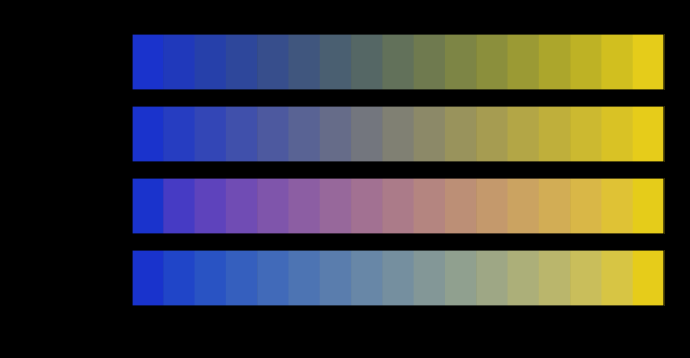
A gradient is a path
Two colours fix the ends of a blend and nothing else. The middle is decided by the space the interpolation happens in, and four spaces in daily use put the halfway point of one ordinary gradient as much as thirty-seven units of colour difference apart.
A difference is not a distance
Two earlier essays here said that CIEDE2000 violates the triangle inequality and left it at that. Searching for the violation finds a detour half the length of the direct route, a smaller one inside a five-unit ball, and a second defect nobody mentions — ΔE94 is not even symmetric.

A deviation is not a difference
The previous round priced twenty departures in colour differences and treated each number as a property of the thing that departed. Every one of them is a product of two factors — how far the reading moved, which is linear and belongs to the departure, and what a unit of that movement is worth where it landed, which is not linear and belongs to the colour. Dimming one surface sixteen times scales the first by exactly sixteen and the second by eight.

A distance raised to a power has no length
CAM16-UCS's colour difference is its Euclidean distance raised to the power 0.63 and multiplied by 1.41. That is still a metric — the triangle inequality holds on every one of four thousand random triples — and it has no length. A grey ramp from black to white measures 25 units in one step, 137 in a hundred and 755 in ten thousand, growing as the number of steps to the power 0.37, and halving the size of a step triples the number of steps that fit.

Two uniform spaces disagree about between
ΔE₀₀'s own local behaviour says which colours lie between two colours, and so does CAM16-UCS's. They do not agree. On cyan to magenta the two shortest paths run fifteen CIELAB units apart — more than either runs from the straight line — and on that gradient ΔE₀₀ would rather have the straight line than CAM16-UCS's answer. Getting the comparison at all takes noticing that one of the two has no local metric: its published difference is a Euclidean distance raised to the power 0.63, and a power below one has an infinite derivative at zero.
Named alongside it
The objects these essays reach for when they reach for this one.
CIEDE2000CIELABPerceptual uniformityColour differenceΔEGradientSpecificationInterpolationAssertionAuditChromaCIECAM16