Diffusion — where it appears
Named by 3 essays across one field — each of them below, with the objects they name alongside it.
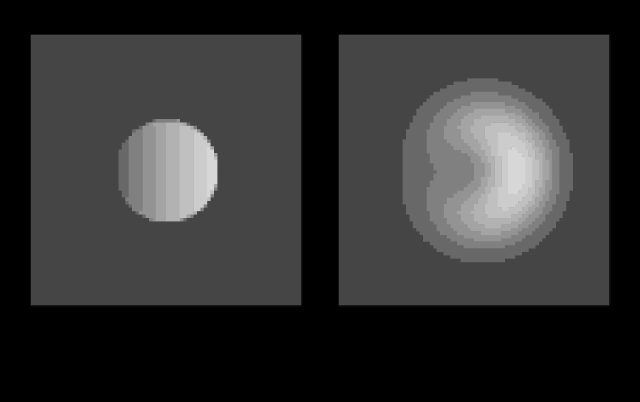
A pool with an edge
A Gaussian pool says how much of a stabilised image survives and can say nothing about what the remainder looks like, because a Gaussian has no edge. Give the pool a boundary and the interior of a faded region takes the average of its own border — exactly, by the mean value theorem, arriving as a prediction about appearance.

A gap in the drive, not in the wall
Break the contour around a region and leave its border signal unbroken, and the interior does not move by one part in a million — a ring of driven cells encloses a centre whatever the wall outside it is doing. Break the signal too and the shortfall goes as the square of what is missing. All of what a gap costs is the piece of border that stopped driving.

A surface has a kernel
Light that enters a translucent material does not come back where it went in. It scatters some thousands of times and leaves a few millimetres away, so what the surface has is not a reflectance but a function of distance — and the reflectance the model wants is that function's integral over the whole plane, which no instrument ever collects.
Named alongside it
The objects these essays reach for when they reach for this one.
AssertionContourFilling inLocal adaptationTroxler fadingAbsorptionColour appearanceDiffusion lengthEccentricityIllusory contourKubelka munkPoint spread function