The collection

Every essay — page 28

Page 28 of 40, continuing through the fields in the same order.

What light is What the eye does Matching and measuring Difference and uniformity What the brain does What a scene does What a camera does Where the model breaks What it takes to deliver it

SeriesObserversNamed objectsRefutationsSearch

What a scene does

A reflectance measured on a patch is a patch. Put it in a room and the light bounces, and a bounce is a multiplication — so shadows carry their own illuminant, highlights carry the lamp, and two surfaces that matched go on matching only until the second bounce.

One film, five viewing angles. The same 340 nm film seen from 5 directions. Nothing about the object has changed — not the light, not the material, not the thickness — and the colour swings by ΔE00 = 42. A pigment's spectrum contains no path length and no angle, so it cannot do this; a film's contains both. This is the clean separation between structural and pigmentary colour, and it is geometric rather than chemical.

A colour that moves with the viewer

A thin film has no pigment in it. Its reflectance spectrum is an interference condition containing a path length and an angle, so tilting the sample moves every maximum to a shorter wavelength and changes the colour by 40 units of ΔE. A pigment's spectrum contains neither, and cannot do this at all — which is the cleanest separation between the two kinds of colour there is, and it is geometric rather than chemical.

7 figures
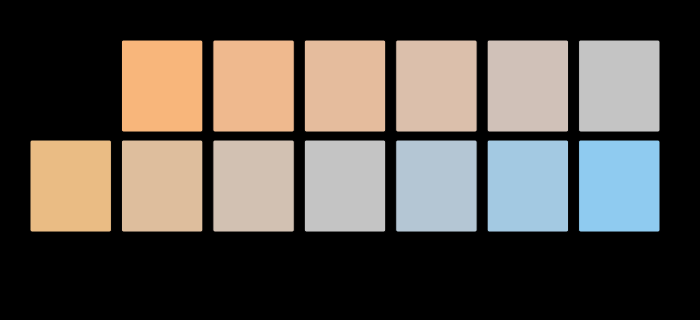
What no surface can be more colourful than. The MacAdam limits at 4 lightnesses under D65, each computed by sweeping two-transition reflectances over the whole band and keeping those that land at the target luminance factor. This is a physical bound rather than a gamut: a reflectance above 1 is a surface that emits, so no pigment anybody invents will ever put an object colour outside these curves. The boundary shrinks steeply as the surface lightens, from 0.310 at Y = 0.1 to 0.028 at Y = 0.9 — a very light surface has almost no room to be colourful, and that is physics rather than pigment chemistry. Drawn against it is sRGB at the same luminance factor rather than as a primary triangle, because a triangle is what a display can reach at some luminance and the bound is what a surface can reach at one; matched properly, sRGB covers 36% at Y = 0.1, 40% at Y = 0.3, 40% at Y = 0.6, 21% at Y = 0.9. The faint triangle is the familiar figure, kept only to show how much it misleads.

No surface can be that colourful

There is a hard bound on object colour that no pigment will ever move, and it follows from a reflectance being at most 1. Its boundary is generated by two numbers, it shrinks by a factor of eleven from dark to light — and measured against it properly, sRGB reaches 40% of what a surface could be at mid lightness while Rec. 2020 reaches 106%.
8 figures
One white balance across a scene lit by two lamps. A neutral surface of albedo 0.6 under 7 mixtures of A and D65, corrected by one diagonal transform chosen for the middle of the run — which is what a camera does when it estimates a single illuminant. The middle patch comes out neutral to ΔE00 = 0.00 and both ends do not: 19.8 at the A end and 16.9 at the D65 one. The failure is structural rather than a matter of a better estimator: white balance is one transform for the whole image, and a scene with two lamps in it has no single answer for that transform to be. Every patch here is the same surface.

A scene has no white point

White balance is one transform applied to a whole image, and a scene lit by two lamps has no single answer for that transform to be. The failure is structural rather than a matter of a better estimator — and every colour-managed workflow in existence takes exactly one white point as an input, with no field in which to say there were two.
6 figures
A glossy surface returns two spectra, and only one of them is the paint. The dichromatic reflection model, computed rather than assumed. Light that enters a dielectric binder, scatters off pigment and comes back carries the reflectance — the body component, ΔE00 = 33.7 from the lamp. Light reflected at the interface never entered, so it carries the lamp's spectrum with only Fresnel's slight dispersion on it: ΔE00 = 1.14. The interface term is computed from Fresnel's equations on a Cauchy index at 45°, so its near-neutrality is a result here rather than an assumption. This is why a highlight is the one region of a photograph that tells a white balancer what the light was, and why removing highlights removes the evidence.

Gloss changes the measurement

The same sample measured with the specular component included and excluded returns two different numbers, and both are correct answers to different questions. Colour is one of four appearance attributes and the only one most instruments report — so a specification that names a colour has silently named a geometry too, and usually does not say which.

9 figures
A corner moves the spectrum and the viewing condition at once. A coloured patch in a corner of coloured walls, against how enclosed the corner is. The top curve is what a colorimeter set up at the door reports: light that has bounced carries the surrounding reflectance again, so the patch is lit by something the room is not. The middle curve is what is left once the patch is read against the corner's own white — most of it goes, because a corner is a change of illuminant and that is what chromatic adaptation is for. The bottom curve is the other thing a corner is: a brighter place, 1.76 times the light, which moves the appearance through the Hunt effect with the white point held still and cannot be adapted away at all.

A corner moves both terms

The interreflection essays compute what a corner does to a spectrum, which is one of the two things a corner does. It is also a brighter place with a differently coloured background — a viewing condition, not a stimulus — and adaptation removes most of the first and none of the second. At an enclosure of six tenths that is 63 per cent of seven units gone and a further unit arriving from the extra light alone.

8 figures
The same wall, applied once and applied twice. A room lit by light that has bounced off its own walls is a change of illumination like any other, and a corner is the same change applied twice. Squaring a reflectance sharpens it, a sharper change of light is further from being a gain, and the residual an adapted observer is left with therefore grows faster than the change does: the second bounce is 1.33 times the change and 1.96 times the residual. This is the adaptation half of what a corner does to a metameric match.

The same wall applied twice

A bounce off a painted wall is a change of illumination, and adaptation handles it about as well as it handles a change of colour temperature. A corner applies the same reflectance twice, which sharpens it — and leaves an adapted observer with 1.96 times as much for a change only 1.33 times as large.

7 figures
A sample with two reflectance curves, and neither below one. The apparent reflectance of an optically brightened sample, measured under D65 and A. It exceeds 1 — the shaded band — which no reflector can do: more light leaves at these wavelengths than arrives at them, because the sample absorbs in the violet and re-emits in the blue. And the two curves differ, so the sample has no single reflectance to store. The effect drawn here is a floor: most of the excitation band lies below 380 nm, outside the range computed here.

A surface that is not a multiplication

Every argument here about what light does to a surface begins by multiplying two spectra together. A surface with a brightener in it takes light at one wavelength and returns it at another, so it is a full operator rather than a diagonal one — and it does not have a reflectance at all.

7 figures
Two sheets with the same reflectance and two different colours. A brightened sheet and a dyed one built to match it under an instrument with no ultraviolet. Under that instrument the pair agrees to ΔE00 0.00, which is a rounding and is true by construction — the dyed sheet's reflectance is the curve the brightened one measured. Under an instrument that includes the ultraviolet they are 7.1 apart, and under daylight 10.6. This is not ordinary metamerism: the two sheets do not differ in reflectance anywhere the eye can see, so no change of light puts them back together and no adaptation removes the difference. One of them is a curve and the other is an operator.

Two sheets that match until the window

Ordinary metamerism is two reflectances that agree under one light and not another, and it can always be undone by putting the first light back. A dyed sheet and a brightened one have the same reflectance everywhere an eye can see, agree exactly under any lamp with no ultraviolet, and separate by ten units under daylight — and no change of light puts them back together.

7 figures
What a sheet of glass takes out of the band a brightener eats. The transmittance of four glazings across the short-wave band, with the brightener's own absorption shaded underneath. The overlap between a curve and the shading is what the sheet behind that glass has to work with. Ordinary window glass stops below about 310 nanometres and leaves most of the band; laminated glass has a plastic interlayer that was put there to hold the sheet together in a crash and happens to absorb almost to 380; a filter sold to protect a print removes the band entirely. The curves are logistic edges at stated wavelengths rather than measurements of particular products.

The window is part of the light

A viewing condition here has always been a spectrum and a geometry. For anything fluorescent it needs a third thing — the transmittance of whatever the daylight came through — because ordinary window glass, a laminated windscreen and a museum filter remove three quite different parts of the band a brightener eats, and the sheet is a different colour behind each.

6 figures
How short of determining the light a photograph is, as the scene grows. Each cell is the number of unknowns left over after every equation the image supplies: three sensors, a three-dimensional illuminant, and reflectances confined to a linear model of the dimension on the left. At one and two dimensions more surfaces close the gap. At three the gap never closes, because each further surface adds three equations and three unknowns; at four it widens. The count is arithmetic and has no algorithm in it.

An image does not determine the light

A photograph of a scene under one illuminant gives three numbers per surface and asks for the illuminant plus three numbers per surface. The count closes only if reflectances lie in a two-dimensional model, and no number of surfaces helps — at three dimensions the alternative scenes can be written down, and they reproduce every sensor response exactly.
6 figures
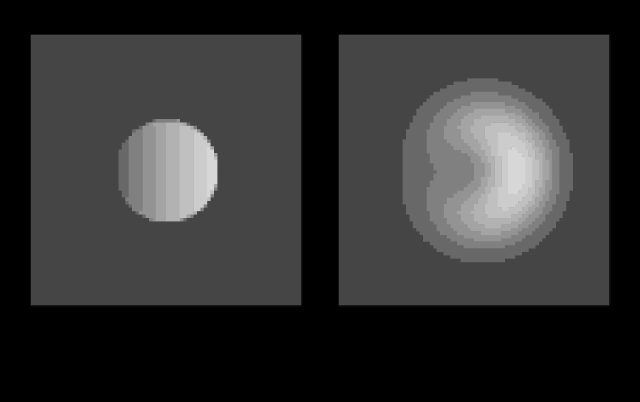
The same border signal, filled in with a boundary and without one. Two fields, each 6 degrees across. The signal is injected along a ring just inside a contour and varies around it, brightest on one side and dimmest on the other. On the left the signal diffuses and the contour is impermeable: the interior settles to 1.000 against a border mean of 1.000, which is the mean-value property of a harmonic function arriving as a prediction about appearance. On the right the same signal is handed to a Gaussian pool of 0.5°, which has no notion of inside: it reaches 0.040 at the centre, because a kernel weights the near rim more than the far one and a filled region does not.

A pool with an edge

A Gaussian pool says how much of a stabilised image survives and can say nothing about what the remainder looks like, because a Gaussian has no edge. Give the pool a boundary and the interior of a faded region takes the average of its own border — exactly, by the mean value theorem, arriving as a prediction about appearance.

8 figures
A gap in the wall and a gap in the drive are not the same gap. What the centre of a region settles to under three conditions. With the contour closed it reaches its border's value exactly. Open a 16% hole in the barrier and leave the border signal unbroken and it still reaches it, to 1e-8 — a ring of driven cells encloses the centre whatever the wall outside it is doing, so nothing can escape. Break the signal too and it falls to 0.960. All of what a gap costs is the piece of border that stopped driving, and none of it is the hole.

A gap in the drive, not in the wall

Break the contour around a region and leave its border signal unbroken, and the interior does not move by one part in a million — a ring of driven cells encloses a centre whatever the wall outside it is doing. Break the signal too and the shortfall goes as the square of what is missing. All of what a gap costs is the piece of border that stopped driving.

8 figures