The thread: Say which colour — page 2
 Matching and measuring
Six numbers make a space
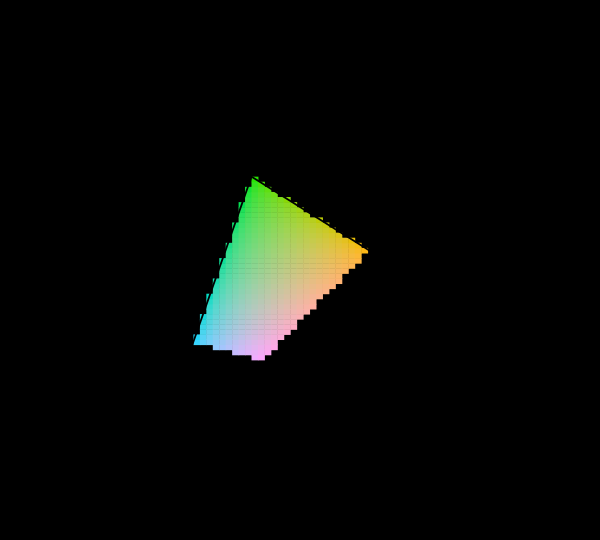
An RGB colour space is eight numbers — three primary chromaticities, a white point, and a transfer function — and everything else about it is derived. Deriving it rather than copying the matrix is the difference between having a colour space and having a table somebody else computed.
 What light is
The sun is not one illuminant
Daylight is not a blackbody and is not one spectrum. It is a one-parameter family reconstructed from three measured basis functions, its chromaticities lie on a curve that is near the Planckian locus and not on it, and the difference is the reason a colour temperature needs a second number beside it.
 What a scene does
A bounce is a multiplication
Colorimetry multiplies an illuminant by a reflectance once and integrates. A surface in a room is lit by every other surface the lamp reached first, so the spectrum arriving at the eye has been multiplied several times — and the second multiplication is where the whole apparatus of matching starts to come apart.
 What a scene does
A shadow has its own illuminant
Outdoors there are two lights, not one. The direct beam is a radiator reddened by the atmosphere; the sky is precisely the power that reddening removed. A shadow is lit by the second alone, so shadowed ground and sunlit ground sit under illuminants 21 units of ΔE apart — before any surface, any eye or any opinion is involved.
 What a scene does
The highlight is the lamp
Light reflected at the surface of a glossy material never entered it, so it never met a pigment. Fresnel's reflectance varies by 5.5% across the visible band and the paint underneath varies by a factor of twenty — which makes a highlight the one region of a photograph that reports what the light was rather than what the object is.
 What a scene does
Rendering in three numbers
Almost every renderer ever shipped bounces red, green and blue rather than a spectrum. The error that costs is exactly zero at the first product and grows at every one after it — because three numbers cannot carry a product they were never given the factors of, and each bounce is another product.
 What a scene does
What a white wall costs
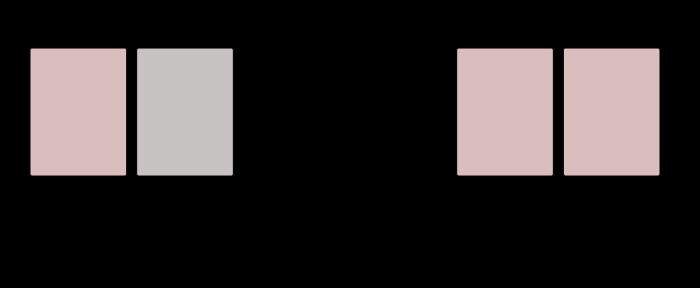
A closed room returns 1/(1−ρ) times the light that entered it, computed band by band — so a paint that is five percent off neutral becomes a strongly coloured illuminant once the room has finished bouncing. The gain amplifies the tint along with the brightness, and the last few percent of albedo cost far more than the first.
 What a scene does
The room is the illuminant
Colour bleeding is usually described as an aesthetic phenomenon of rendered images. It is better described as a measurement. In a room with one lamp, five of six surfaces emit nothing at all, so their light is entirely a product of other surfaces' reflectances — and the bleeding saturates rather than running away, for a reason worth deriving.
 What a scene does
Paint is not a filter
Stacking two filters multiplies their transmittances. Stirring two pigments together does not multiply their reflectances, because a mixture is one scattering layer rather than two in series — light meets whichever particle is nearest. Treating the two as the same operation is a 15-unit error, and which way it errs turns out to depend on whether the comparison holds the amount of pigment fixed.
 What a scene does
Why blue and yellow make green
The oldest fact in colour, and the usual explanations are wrong. It is not because green sits between blue and yellow, and it is not a fact about the eye at all — it is that the only band both pigments return is their overlap, and the overlap of a blue and a yellow reflectance is green. Computed, the mixing path bows away from the straight line by a measurable amount.
 What a scene does
The colour is in the thickness
Transmittance is exponential in path length and the observer is linear, so doubling the depth of an absorbing medium squares the transmittance rather than halving the colour. A translucent object therefore has no one colour — its thin edge and its thick middle are different spectra of the same substance, and the hue moves between them.
 What a scene does
A colour that moves with the viewer
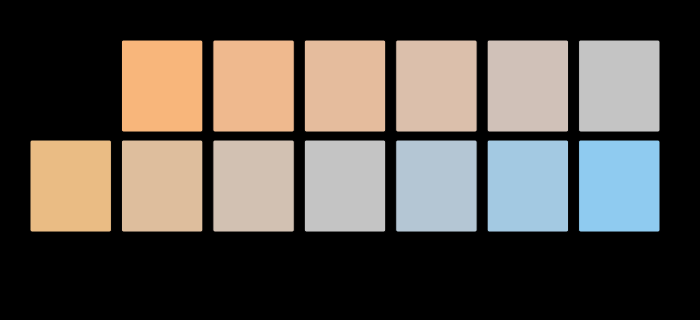
A thin film has no pigment in it. Its reflectance spectrum is an interference condition containing a path length and an angle, so tilting the sample moves every maximum to a shorter wavelength and changes the colour by 40 units of ΔE. A pigment's spectrum contains neither, and cannot do this at all — which is the cleanest separation between the two kinds of colour there is, and it is geometric rather than chemical.
 What a scene does
A scene has no white point
White balance is one transform applied to a whole image, and a scene lit by two lamps has no single answer for that transform to be. The failure is structural rather than a matter of a better estimator — and every colour-managed workflow in existence takes exactly one white point as an input, with no field in which to say there were two.
 What a camera does
A camera is a fourth observer
The 1931 functions, the 1964 functions and a person's own cones are three sets of three curves that collapse a spectrum onto three numbers. A camera is a fourth, built from silicon and dye rather than from pigment and neural wiring, and it agrees with none of them.
 What a camera does
Raw is not a picture
A raw file is three integrals per site and a list of decisions nobody has taken yet. Every one of those decisions has a defensible answer and none of them has a correct one, which is why two converters open the same file and disagree.
 What a camera does
The filter that makes colour possible
An infrared-cut filter is not a refinement on a colour camera. Removing it collapses the separation between the three channels by a factor of nearly nine under tungsten, and the component that keeps colour photography working is the one nobody photographs.
 What a camera does
A camera profile is a fit
Since no matrix is exact, the one a manufacturer ships is a least-squares compromise over a set of surfaces somebody chose. Fitted on desaturated patches it is excellent on desaturated patches — and the sample set is a hidden argument to every camera profile in existence.
 What a camera does
A photograph is not a measurement
A photograph is a measurement made by an instrument whose kernel nobody published, under an illuminant nobody recorded, corrected by a matrix fitted to somebody else's surfaces, with two thirds of every pixel invented. It supports relative claims well and absolute ones badly, and it is used for the second.
 What it takes to deliver it
A halftone is not a mixture
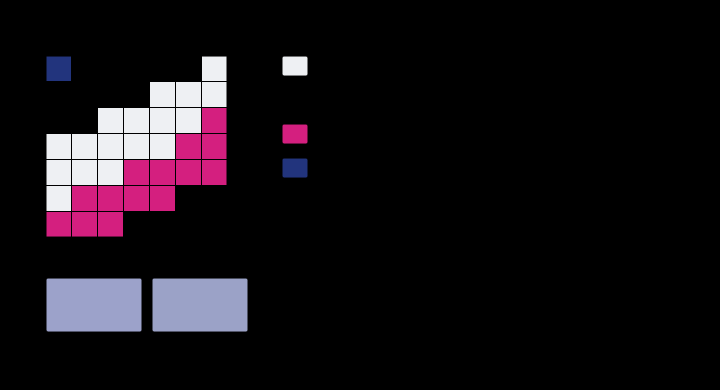
Forty per cent cyan and thirty per cent magenta are not stirred together anywhere. They are laid down as dots, and the sheet is a mosaic of four fully-inked regions in proportions the two coverages fix — which is why the colour is an area average of four spectra rather than a blend of two, and why it lands nowhere near where mixing would put it.
 What it takes to deliver it
Neither gamut contains the other
Converting a picture to CMYK is described everywhere as a reduction, as though the press were a smaller version of the screen. Measured as solids, the press reaches eleven per cent of its volume outside sRGB while sRGB reaches fifty-four per cent of its volume outside the press — and in the cyans the press wins by seventy per cent of chroma.
 What it takes to deliver it
The paper is the white point
A printed colour is reported against the sheet it sits on rather than against the light in the room, and the choice is a switch in every colour engine. Flipped one way, the same separation on coated stock and on newsprint is a 3.04 colour difference; flipped the other, it is 0.13 — and the two answers are about different questions.
 What it takes to deliver it
The fourth ink is not for colour
Black is in every process set and it extends the gamut by more than a third — and at every lightness above about forty it extends the chroma boundary by exactly nothing. What it buys is depth at the bottom, a neutral that holds its hue when the press drifts, and a way to put a full-strength dark on a sheet that could not carry three inks' worth of it.
 What it takes to deliver it
The separation is not unique
A four-ink press has one more control than a colour has numbers, so most colours can be printed several ways. The alternatives agree to a hundredth of a colour difference under the light the match was made in — and they are metamers of one another, so under a tungsten lamp the same eleven separations of one colour spread by nearly seven.
 What it takes to deliver it
A brand colour is an ink
A named colour is a jar of pigment with a spectrum, and a four-colour build of it is three inks arranged to integrate to the same three numbers. Of 156 constructed single-pigment inks, 15 can be matched at all — and those fifteen drift by a median of 3.8 colour differences under a tungsten lamp, because the match was never a match.
167 essays on this thread, page 2 of 7 · all threads · all essays