The thread: Say which colour — page 3
 What it takes to deliver it
The screen is not the room
A thousand-to-one display in an ordinary office is a hundred-and-thirty-seven-to-one display, and the signal value that means black comes out at the lightness of a dark grey card. Nothing is wrong with the panel. Light falls on the screen and comes back off it, and the two per cent it returns is added to every pixel — most of all to the ones with nothing else in them.
 What light is
Two lamps do not average
Light adds, band by band, and every number a lamp is sold by is a projection of the sum rather than a sum of the projections. Two radiators sitting exactly on the Planckian locus mix into a light that is measurably pink; two poor lamps mix into a better one than either.
 What light is
There is no D65 lamp
D65 is standardised by three numbers, and three numbers do not pin a spectrum. A source built to hit them exactly — matched to a part in a billion, with a third of the visible band nearly empty — separates pairs that D65 says are identical by up to eight and a half units of colour difference.
 Matching and measuring
Five nanometres is a choice
Every integral here is taken in five-nanometre steps, and the interval has never had to be defended. Coarsening it to twenty costs daylight two hundredths of a colour difference and a fluorescent tube six and a half — and which way of coarsening is used decides a further factor of six.
 Matching and measuring
A gradient is a path
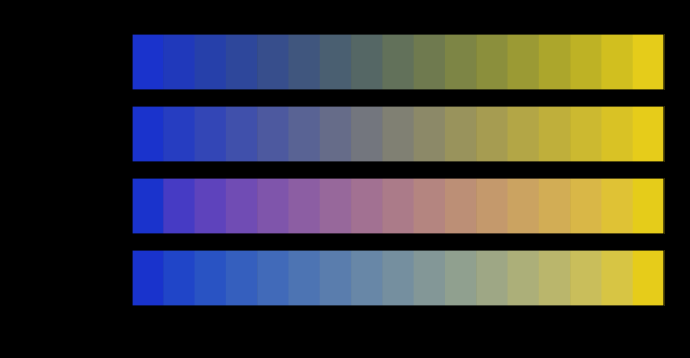
Two colours fix the ends of a blend and nothing else. The middle is decided by the space the interpolation happens in, and four spaces in daily use put the halfway point of one ordinary gradient as much as thirty-seven units of colour difference apart.
 Difference and uniformity
A difference is not a distance
Two earlier essays here said that CIEDE2000 violates the triangle inequality and left it at that. Searching for the violation finds a detour half the length of the direct route, a smaller one inside a five-unit ball, and a second defect nobody mentions — ΔE94 is not even symmetric.
 What the brain does
There is no brown light
Brown is dark orange, dark is a ratio to a white, and a light in a dark room has no white to be dark against. The same stimulus, unchanged in XYZ, runs from lightness 152 to lightness 16 as the surround is raised — and only the bottom of that range has a name.
 What light is
White is a region
A lamp is not sold as a chromaticity. It is sold as 4000 K, and what that means is that its chromaticity fell inside a quadrangle — which two lamps can occupy at opposite corners, eleven ΔE00 apart. In a room with either of them, the same twelve surfaces differ by one unit.
 What light is
A screen is a poor lamp
A display's white is a light. Shone on a surface it renders colour worse than a fluorescent tube — and the wider the gamut, the worse it gets, because the narrow primaries that buy a large triangle are exactly the ones that leave holes in the spectrum.
 Matching and measuring
One match names the observer
A yellow at 589 nanometres set against a mixture of 545 and 670 is two equations in two unknowns. It has one solution for a normal observer, a solution somewhere else for an anomalous one, and no unique solution at all for a dichromat — whose two equations are one equation twice.
 Matching and measuring
A catalogue is not a vocabulary
A colour order system is a regular lattice, because a person has to be able to find a page. Sorted by what its chips would be called, that lattice comes apart into piles differing by a factor of three — and a fifth of all one-step moves in it change the name.
 Matching and measuring
Four primaries have a choice
Three primaries matching three numbers have one answer. Four have a family of them, every member exact to floating point for the observer they were solved for — and the members are not equally good for anybody else, so a display with a fourth primary has a setting that is robust to who is looking at it and a setting that is not.
 Difference and uniformity
A tolerance is a probability
A colorimeter reports one number and a specification compares it with another, and both are computed for an observer who does not exist. Handed to two hundred people, the same pair at ΔE00 1.0 is read from 0.8 to 3.7 — and which of those two ranges applies depends on something no specification records.
 Difference and uniformity
Three constants nobody quotes
CIEDE2000 is defined with three parametric factors in it, the CIE leaves them to the industry using the formula, and the two settings in ordinary use differ by a factor of two in one of them. Twenty-nine per cent of acceptance decisions change between the two — a larger disagreement than any between the formulae themselves.
 Difference and uniformity
A mean is not a difference
A specification for a proof, a profile or a print run is written against a set of colours and has to reduce that set to one number. The mean and the ninety-fifth percentile disagree about which of two reproductions is better in thirty per cent of cases, and both numbers are honest.
 What light is
A lamp has a direction
A white LED is a blue die under a converter, and light leaving at an angle has travelled further through the converter than light leaving straight up. So the mixture is different in every direction, the beam is bluer in the middle than at its edge, and the number on the box is one direction's worth of a device that has no single colour.
 What light is
Three ways to dim a lamp
"Dimmed to ten per cent" names three different colours. Switching the lamp on and off faster than anybody can see changes the chromaticity by nothing at all — exactly, to floating point. Reducing the current moves it a few units. Reducing the power to a filament moves it eighteen hundred kelvin down the Planckian locus, and stays on the locus exactly the whole way.
 What the eye does
One person is two observers
The macular pigment is a yellow screen over the fovea and nowhere else, so a cone at the centre of gaze and a cone ten degrees away have different colour-matching functions in the same eye. A match made in the middle comes apart at the edge by six units — and fitting one filter to the gap between the CIE's two standard observers gives a density of 0.40 against a measured 0.35.
 Matching and measuring
A fourth primary is a design
A display's fourth emitter is sold as more colour. Optimised instead against how far apart two hundred eyes are about its white — with the gamut held fixed so it cannot cheat — it buys agreement, and two and a half times closer together than three primaries reaching the same area, and the wavelengths it chooses are not the ones anybody would pick.
 What the brain does
A name moves with the room
Eleven basic colour terms are quoted as centroids in CIELAB and a colour is named by which one it is nearest. Two things nobody records decide the answer — which distance function is used, which renames a fifth of the displayable gamut, and which room the colour is in, which renames more than a quarter of it.
 What the brain does
A name in the model's own words
The eleven basic colour terms move when the room does, and the obvious objection is that they were being measured in a space with no room in it. Quoting them in an appearance model's own coordinates instead does not shrink the renaming — it grows it by four per cent — and the space alone renames an eighth of the gamut with the room held still.
 What light is
The tables do not stop together
This collection integrates from 380 to 780 nanometres, and decided once, in writing, that the range could not honestly be widened. The argument was correct at the long end and wrong at the short one — the CIE publishes the daylight basis from 300 nanometres, and publishes it from there for exactly the reason it matters.
 Matching and measuring
The eye weights where the light is not
A brightened sheet returns a quarter more light than arrives at 430 nanometres, and it is three tenths of one per cent brighter for it. The luminous efficiency function is 0.017 there against 1.0 in the middle of the band, so the whole effect lands in the blue-yellow axis — brighter than white is a colour claim wearing a brightness word.
 What a scene does
Two sheets that match until the window
Ordinary metamerism is two reflectances that agree under one light and not another, and it can always be undone by putting the first light back. A dyed sheet and a brightened one have the same reflectance everywhere an eye can see, agree exactly under any lamp with no ultraviolet, and separate by ten units under daylight — and no change of light puts them back together.
167 essays on this thread, page 3 of 7 · all threads · all essays