The collection

Every essay — page 38

Page 38 of 40, continuing through the fields in the same order.

What light is What the eye does Matching and measuring Difference and uniformity What the brain does What a scene does What a camera does Where the model breaks What it takes to deliver it

SeriesObserversNamed objectsRefutationsSearch

What it takes to deliver it

A colour that stays where it was measured is nobody's problem. This is the apparatus that carries one to somebody else — ink on a sheet, a profile, a rendering intent, a proof, and a room — and every stage of it is a map that loses something, chosen deliberately.
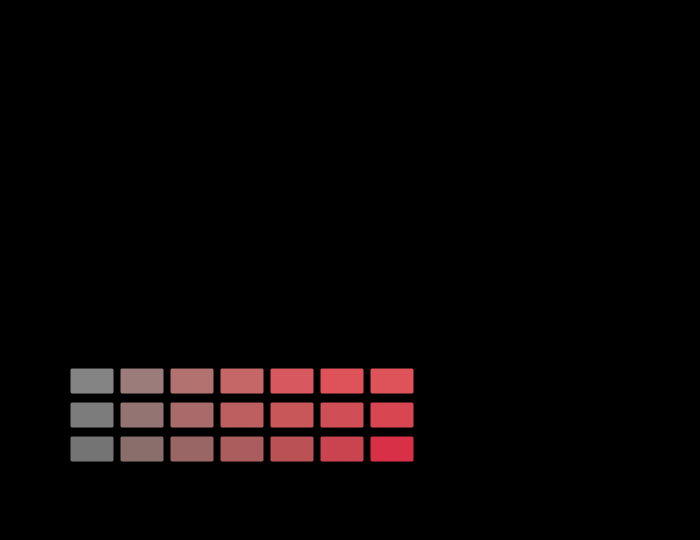
A gradient of one hue, mapped into a press's gamut 3 ways. Chroma asked for along the bottom, chroma delivered up the side, for a ramp at lightness 55 and hue angle 25°. A colorimetric intent follows the diagonal until the press runs out and is flat afterwards — the flat part is a gradient arriving as a single colour. The perceptual intent is under the diagonal from the start, which is the price of never going flat.

A budget drawn through one hue

The three-stage error budget this collection publishes for a colour-management chain is computed over twenty-four colours of a single hue at a single lightness. The quantity that actually varies with hue — how many distinguishable colours a rendering intent destroys — runs from nothing at all to more than a third, and the hue the budget uses is near the bottom of that range.

9 figures
Pairs built to sit exactly on a ΔE2000 tolerance, read in every other unit. Twenty-four pairs of surfaces, each constructed by walking one member along a fixed direction until the difference is exactly 1.0 ΔE2000 under D65. The bar spans what those same pairs read in each unit, after calibration, with the tick at the mean. ΔE2000's own row is a point at 1.0 by construction. Every other unit spreads them: ΔE*uv reads them from 0.69 to 1.75, so a contract written at "one unit" accepts and rejects a different set of deliveries depending on which unit it means. CAM16-UCS rejects all twenty-four: it reads the closest of them at 1.43.

A tolerance is a boundary through pairs

Twenty-four pairs of surfaces built to sit exactly on a ΔE2000 tolerance of one read from 0.69 to 1.93 in the other five units. A contract quoting "one unit" without naming the formula does not become slightly wrong in another; it accepts and rejects a different set of deliveries, and in one case rejects every single one.

7 figures
Every figure a surround dial would apply to, weighed. The eleven generators in the appearance family, by the size of the drawing each emits — which is what a dial multiplies, because every frame carries the figure's whole body. The dashed rules are the thresholds the dial policy here is written in: under 3 KB gets thirteen stops, under 6 gets nine, under 10 gets seven, and above about 12 KB nothing gets a dial at all. The median body here is 2.25 KB and 4 of the eleven are inside the most generous tier, against a policy written when the distribution had a median of 4.0 KB. Two phases deferred a surround dial on the grounds that appearance swatches are not small. The exception is unique-hues at 14.1 KB, which is over the ceiling that says it should have no dial — and it has one, on chroma, declared in the same file as the ceiling.

A dial has a price

Two rounds declined to give the appearance model's surround a continuous control, both times because the frames would be too heavy, and neither time was the weight taken. It is 2.25 kilobytes at the median — the light end of these figures rather than the heavy end — and one figure is already breaking the rule the deferral was made under.

4 figures
The share of a sample's reflectance an aperture recovers, by how wide it is. Six materials, and the fraction of each one's true reflectance that a measurement recovers through an aperture of the stated radius. The horizontal axis is logarithmic in millimetres; the vertical is a share, so 1.0 is the whole of it. The dashed line is a 4-millimetre radius, which is about what a hand-held spectrophotometer has. At that aperture coated paper reads 98 per cent of its own reflectance and candle wax reads 48. Every curve approaches one from below and none of them reaches it: the kernel's tail is what is being cut, and it falls as one over the aperture rather than exponentially.

An aperture is a filter

A measuring aperture throws away the light that came back outside it, and the light that comes back furthest is the light at the wavelengths the sample absorbs least. So an aperture does not attenuate a translucent sample evenly — it attenuates its peaks more than its troughs, which is a filter whose transmission curve the sample itself decides.

7 figures
The share of a sample's reflectance an aperture recovers, by how wide it is. Six materials, and the fraction of each one's true reflectance that a measurement recovers through an aperture of the stated radius. The horizontal axis is logarithmic in millimetres; the vertical is a share, so 1.0 is the whole of it. The dashed line is a 8-millimetre radius, which is about what a hand-held spectrophotometer has. At that aperture coated paper reads 99 per cent of its own reflectance and candle wax reads 66. Every curve approaches one from below and none of them reaches it: the kernel's tail is what is being cut, and it falls as one over the aperture rather than exponentially.

Either disc can be the wide one

Every standard on translucent samples says to illuminate a larger area than is measured, and explains it by saying that light leaks out of the lit spot. That is true and it is not the reason, because the instruction works equally well the other way round — measuring a larger area than is lit gives a reading just as exact. The error is a product of two apertures and either one being wide kills it.

7 figures
Four departures from the model equation, each at an ordinary strength. What each of the four assumptions inside a colour integral costs, in ΔE₀₀, on a stated sample under a stated light. The wavelength index is a coated printing paper measured with and without the ultraviolet of D50; the range is the same paper integrated from 300 nanometres and from 380; the place index is a pigmented plastic through a four-millimetre radius; the direction index is an eggshell paint beside a window. The spread is a factor of 7.0. This is a ranking of four examples rather than of four departures — each of them can be made larger by choosing a more extreme sample, and the marble in the same collection of materials reaches 12.7 on the index that comes third here.

Which index to buy an instrument for

Four departures from the colour integral, ranked by what they cost and by what it would take to remove each one. The ranking by cost and the ranking by price are almost exactly reversed — the two largest are removed by specifying a lamp and by widening a table, and the two that need new hardware are the two smallest.

7 figures
The conditions under which an observer's departure is exactly zero. A departure of the observer is the pairing of something belonging to the observer with something belonging to the stimulus, so emptying either factor empties the product. The axis is logarithmic in what is left when the condition is imposed. Six rows empty the stimulus's factor — a perfectly neutral sample is the same colour for every observer, at any age and any field size — and two empty the observer's, since a gain on each cone and a change of basis are both absorbed exactly. All eight are identities rather than small numbers. The last two are the same two conditions imposed in a published cone space rather than in the observer's own, and they are worth eight and thirteen units: the identity is about the eye, and the arithmetic everybody uses is in somebody else's coordinates.

The instrument is one observer exactly

A spectrophotometer has no observer uncertainty. It computes through the 1931 tables to the last bit, reproducibly, forever — which is its whole value and is also why it cannot report the three colour differences of observer spread between itself and whoever is looking at the sample.

5 figures
Every departure under every light. Six departures across six lights, each cell the difference between two observers in ΔE₀₀, drawn as a bar whose length is the number. The rows are not multiples of one another: the lens is worst under tungsten and the pigment peaks are worst under a three-emitter LED, because a departure is a pairing and which light is being paired with decides it. The laser projector's row is empty, and that is not a fact about lasers — on this collection's five-nanometre grid a three-line spectrum is a one-line spectrum, and a single wavelength is a stimulus every observer agrees about exactly.

The booth and the eye disagree

A viewing booth is specified to simulate daylight, and daylight is the light under which observers disagree least. So a booth is the condition in which a specification is least likely to be tested against the thing that breaks it, and the shop it will be judged in roughly doubles the term.

6 figures
Each departure over forty-two surfaces rather than one. The same six departures measured over a family of forty-two analytic reflectances — an absorption band of stated centre, width and depth — with the smallest, the median, the ninety-fifth percentile and the largest marked. Every one of them spans more than a factor of three, and the ranking between them is not stable across the family: what decides a departure's size is which sample it is asked about, because a departure is a pairing and the sample is one of the two factors. Quoting any single number for what an observer's age is worth is quoting a choice of example.

A brand colour for a population

A brand colour is chosen once, specified in a number, and seen by everybody. The observer audit says two candidate colours with identical specifications can carry observer spreads differing by an order of magnitude, and that the spread is computable from an ink's spectrum at the moment the ink is chosen.

7 figures
The budget's three numbers, and the units they are in. The published three-stage budget's own figures, with each one's unit named, beside the same stage re-measured in a single unit over the same colours. Two of the three are colour differences between stimuli and the third is a distance between appearances, and the budget adds them. The fourth row is a stage the budget has no entry for: the colours the separation cannot reach even after the mapping has moved them, which comes to 1.45.

The budget adds two units

This collection publishes a three-stage error budget for a colour-management chain and prints its sum. Two of the three stages are colour differences between stimuli and the third is a distance between appearances, and the conversion between those is not a constant. Re-measured in one unit over the same colours the chain has four stages rather than three, its end-to-end error is 5.05 against a sum of 7.66, and the profile's contribution where a job actually lands is 3.2 times its published average.

7 figures
The same blend, taken on the stored values and on the light. Six pairs blended at 50 per cent, once by averaging the values as they are stored and once by averaging the light they stand for. Every resize, every antialiased edge and every transparency composite in an ordinary pipeline does the first. The two land 15.8 colour differences apart at the mean and 19.3 on a red against a green, and the stored-value blend is the darker on all six, by up to 23 units of lightness.

An average on the stored values

A resize, an antialiased edge, a transparency composite and a chroma subsample are all averages, and in almost every pipeline they are taken on the numbers as stored. The numbers as stored are encoded, the encoding is a compression, and a half-and-half blend of black and white taken that way lands 18.7 colour differences from the half-and-half blend of the light — 22.7 units of lightness darker, on every pair, always in the same direction.

7 figures
The same colour, delivered from two documents. A ramp of chroma, mapped into a press's gamut under the perceptual intent from two source solids: the whole of sRGB, and the same solid with its chroma limited, which is what a document containing only muted colours amounts to. Under a colorimetric intent the two answers are identical to the floating-point floor. Under the perceptual one they are 0.69 apart at the mean and 2.64 at the worst, on colours the destination could hold either way.

An intent is not a function of the colour

A rendering intent is chosen per job and applied per pixel, which suggests it is a function of the colour. The colorimetric ones are, exactly — the same colour from two documents comes out identical to the floating-point floor. The perceptual one is not — it compresses the whole source solid into the destination, so the same colour delivered from a wide document and from a muted one lands 2.6 colour differences apart, on colours the destination could hold either way.

6 figures