Concept

Rendering intent — where it appears

Which compromise a colour conversion makes when the destination cannot reach the source, chosen from a small named set. The choice is about what to preserve — relative differences, exact colours, or the white — and it cannot preserve all three.

Named by 5 essays across one field — each of them below, with the objects they name alongside it.
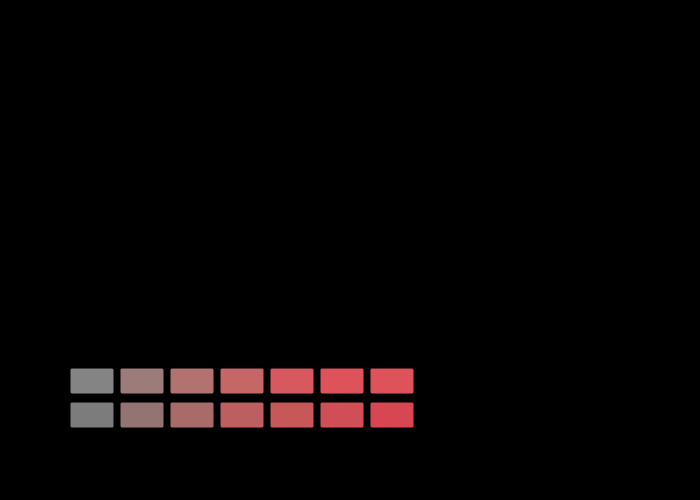
A gradient of one hue, mapped into a press's gamut 2 ways. Chroma asked for along the bottom, chroma delivered up the side, for a ramp at lightness 55 and hue angle 25°. A colorimetric intent follows the diagonal until the press runs out and is flat afterwards — the flat part is a gradient arriving as a single colour. The perceptual intent is under the diagonal from the start, which is the price of never going flat.

No mapping preserves everything

More than half the sRGB solid is outside a press's gamut, so something has to be done with it, and there are two things that can be done. One leaves every reproducible colour exactly where it was and delivers a gradient as a flat area. The other keeps the gradient and moves every colour that needed no help by about three.

applied · Delivery
What a proof on an unbrightened sheet cannot reach. The paper white of a heavily brightened stock beside the paper white of an unbrightened one, both under an ultraviolet-included instrument. They are ΔE00 9.8 apart and 10.3 of that is in the blue-yellow axis. A proofing system on the unbrightened sheet can print towards the brightened one only by adding ink, which makes the paper darker rather than bluer; it cannot add light at 435 nanometres because it has no brightener and its own lamp is the one in the room. This is why a soft proof and a hard proof of the same job disagree about the white, and why the disagreement is in one direction.

A proof cannot glow

A proof is a different sheet of paper pretending to be the production one, and the pretence works by adding ink until the two agree. It cannot work for a brightened stock, because the direction the proof has to travel is towards more blue at the same lightness and every ink a proofer owns moves it towards less light instead.

applied · Delivery
Where a delivered colour's error actually comes from. Three bars and two totals. The profile's interpolation between its nodes contributes 0.13 ΔE00; the rendering intent, at the colorimetric setting, moves nothing that was already printable and contributes 0.00; and looking at the result in a dim room rather than the booth it was proofed in contributes 4.30, which is 97 per cent of the total. The two totals are the three added — 4.43 — and combined in quadrature — 4.30. The gap between those two rules is 0.127, about the size of the entire profile stage, and no standard says which rule to use.

A delivery tolerance is three tolerances

A colour reaches a reader through a profile, a gamut mapping and a room, and each has a number somebody chose. Each has an essay of its own here, and none of those essays had put the three costs in one column. Put there, the stage nobody controls carries ninety-seven per cent of the total.
applied · Delivery
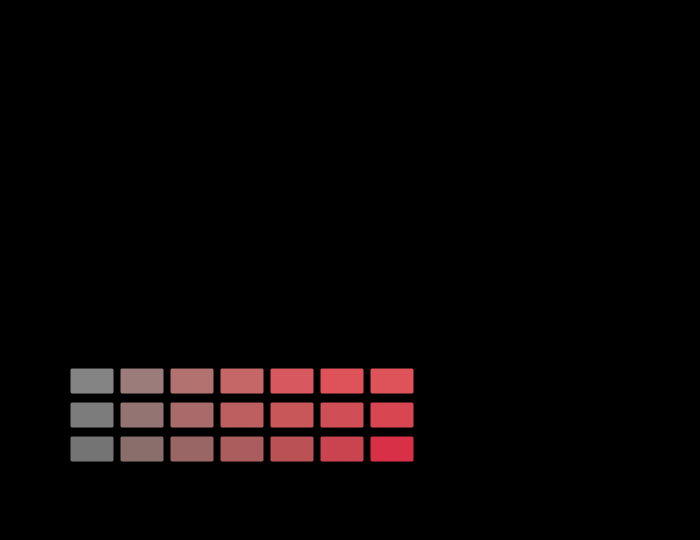
A gradient of one hue, mapped into a press's gamut 3 ways. Chroma asked for along the bottom, chroma delivered up the side, for a ramp at lightness 55 and hue angle 25°. A colorimetric intent follows the diagonal until the press runs out and is flat afterwards — the flat part is a gradient arriving as a single colour. The perceptual intent is under the diagonal from the start, which is the price of never going flat.

A budget drawn through one hue

The three-stage error budget this collection publishes for a colour-management chain is computed over twenty-four colours of a single hue at a single lightness. The quantity that actually varies with hue — how many distinguishable colours a rendering intent destroys — runs from nothing at all to more than a third, and the hue the budget uses is near the bottom of that range.

applied · Delivery
How far the chain falls short of its sum, and how much of that is the unit. For each rendering intent, three ratios of the chain's end-to-end error to the sum of its four stages. The lowest bar is the published one, in the power-corrected unit. The middle bar is what that unit reports for a chain whose stages point the same way and add exactly — the exponent on its own. The top bar is the same chain measured in the model's own Euclidean space. Under the colorimetric intent the published ratio is 0.66, the exponent alone gives 0.74 and the chain in a space that can add 0.84: 77 per cent of the shortfall is the unit.

A chain measured in a unit that cannot add

A delivery chain's four stages, measured in the power-corrected appearance difference, sum to 7.66 while the chain end to end measures 5.05, and the shortfall was read as the stages partly cancelling. A chain whose four stages lay in a straight line and added exactly would still read 0.74 of its sum in that unit, because a distance raised to the power 0.63 cannot add. Measured in the model's own Euclidean space the same chain reaches 0.84 of its sum. Three quarters of the published shortfall was the exponent.

applied · Delivery

Named alongside it

The objects these essays reach for when they reach for this one.

Colour managementGamut mappingThe ICC profileColour differenceSpecificationCIECAM16ClippingDeclared inputGamutToleranceChromaDelivery

All concepts