Dichromacy — where it appears
Named by 7 essays across 3 fields — each of them below, with the objects they name alongside it.
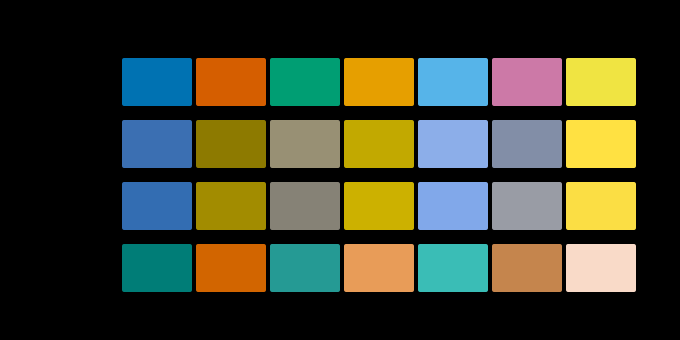
Simulating what cannot be simulated
A colour-blindness simulation cannot show what anybody sees. What it can show is which discriminations survive, and that is a narrower claim, a checkable one, and the only one worth making.

A confusion point is a missing pigment
The nine numbers colour matching leaves free are fixed by three points on a chromaticity diagram, each of them the place where everything one class of dichromat cannot tell apart converges. Two of the three lie outside the diagram entirely, which is not a defect — a direction in tristimulus space need not correspond to a light.

The three numbers a gain cannot see
Colour matching leaves nine numbers free. Three dichromat confusion points fix six of them and three choices of unit fix the rest — and it turns out that a von Kries gain is exactly blind to those last three. So the dichromat data do not merely constrain an adaptation basis. They determine it, with nothing left over to fit.

A template cannot place a point
This collection's model of an eye is good to a few tenths of a per cent at predicting what a cone catches, which is far more than enough to place a spectrum. Asked where that eye's confusion points are, it puts the protanope's at (0.99, 0.20) against a measured (0.75, 0.25) and the deuteranope's anywhere from (1.1, −0.5) to (−18, 11) depending on which stimuli the fit was made over.

Two points out of three
Every published adaptation transform implies three dichromat confusion points, whether or not it was fitted to any. Measured in the population's own standard deviations they are two to fourteen out on the protanope's point and four to twelve on the deuteranope's — and between half a standard deviation and two and a half on the tritanope's, which is inside the population. The claim that these matrices are not cone responses is safe. The evidence for it is two points.

A point about the pigments that remain
The chromaticity at which a protanope's confusion lines meet does not move at all when the long-wave pigment moves — not slightly, exactly not at all. It moves a great deal when the medium-wave pigment does. A dichromat's confusion point is a fact about the two receptors they have rather than about the one they lack.

The band below four hundred
The pigment template every observer here is built from carries a second, smaller absorption band in the ultraviolet, published at 0.26 of the main one. Dialling it from nothing to twice that moves the median observer monotonically away from the standard one, with no interior optimum — which is what a physical constant looks like when nothing downstream is pulling it anywhere.
Named alongside it
The objects these essays reach for when they reach for this one.
Cone fundamentalsConfusion pointBasisDeuteranopiaIdentifiabilityMacular pigmentProtanopiaTritanopiaCAT16Chromatic adaptationColour vision deficiencyDegrees of freedom