Theme

The thread: Computed, not quoted — page 3
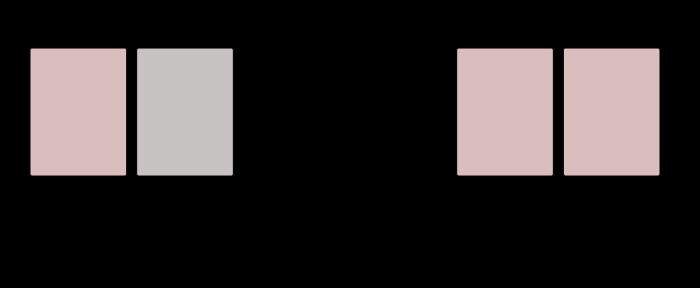
Every swatch begins as a spectral power distribution and is carried through the colour-matching functions as it is drawn. None is a hex code recalled from a table.
Every face of the solved room. The red room after the transport is solved in all 81 bands. Only the ceiling emits; the other five faces are lit entirely by what the ceiling and each other send them, so their colour is the lamp multiplied by every reflectance along every path that reached them. The ceiling itself comes out 1.05× brighter than it emits, because a closed room returns light to its own source. The two chromaticities under each swatch are the spectral solve and the three-channel one, and the faces furthest from the lamp — the ones the light reached by the most bounces — are where they disagree most. What a scene does

The room is the illuminant

Colour bleeding is usually described as an aesthetic phenomenon of rendered images. It is better described as a measurement. In a room with one lamp, five of six surfaces emit nothing at all, so their light is entirely a product of other surfaces' reflectances — and the bleeding saturates rather than running away, for a reason worth deriving.

Mixing two paints and stacking two filters are different operations. The same two reflectances combined two ways. Stacking them as filters multiplies the transmittances, which is right for gels in front of a lamp and wrong for pigment stirred into pigment: a stirred mixture is one scattering layer, not two in series, and light meets whichever particle is nearest rather than passing through both. Kubelka–Munk handles it by moving to K/S = (1 − R)²/2R, in which absorption and scattering add by concentration, and inverting afterwards. The two answers differ by ΔE00 = 15.0, and the filter model is the darker of the two because it charges every photon for both pigments. What a scene does

Paint is not a filter

Stacking two filters multiplies their transmittances. Stirring two pigments together does not multiply their reflectances, because a mixture is one scattering layer rather than two in series — light meets whichever particle is nearest. Treating the two as the same operation is a 15-unit error, and which way it errs turns out to depend on whether the comparison holds the amount of pigment fixed.

Why blue and yellow make green. 7 mixtures between a blue and a yellow pigment, mixed in Kubelka–Munk — K/S summed by concentration and inverted back to reflectance — and plotted against the straight line joining the two endpoints. The path bows towards green by 0.099 in chromaticity, and the reason is in the spectra rather than in the eye: the blue reflects below about 520 nm and the yellow above about 500, so the only band both return is the overlap between them. Mixing lights adds spectra and lands on the chord; mixing pigments intersects them and does not. What a scene does

Why blue and yellow make green

The oldest fact in colour, and the usual explanations are wrong. It is not because green sits between blue and yellow, and it is not a fact about the eye at all — it is that the only band both pigments return is their overlap, and the overlap of a blue and a yellow reflectance is green. Computed, the mixing path bows away from the straight line by a measurable amount.

The same medium at six path lengths. Beer's law at 6 depths of one absorbing medium. The absorption coefficient is a single spectrum and the only thing changing is how far the light travelled, yet the patches differ in hue by 7.8° as well as in lightness — because absorption is exponential in depth and the observer is linear, so the bands that survive at d = 8 are not a scaled copy of the ones that survive at d = 0.25. Path length belongs to the geometry, not to the substance, which is why this sits in a field about scenes. What a scene does

The colour is in the thickness

Transmittance is exponential in path length and the observer is linear, so doubling the depth of an absorbing medium squares the transmittance rather than halving the colour. A translucent object therefore has no one colour — its thin edge and its thick middle are different spectra of the same substance, and the hue moves between them.

One film, five viewing angles. The same 340 nm film seen from 5 directions. Nothing about the object has changed — not the light, not the material, not the thickness — and the colour swings by ΔE00 = 42. A pigment's spectrum contains no path length and no angle, so it cannot do this; a film's contains both. This is the clean separation between structural and pigmentary colour, and it is geometric rather than chemical. What a scene does

A colour that moves with the viewer

A thin film has no pigment in it. Its reflectance spectrum is an interference condition containing a path length and an angle, so tilting the sample moves every maximum to a shorter wavelength and changes the colour by 40 units of ΔE. A pigment's spectrum contains neither, and cannot do this at all — which is the cleanest separation between the two kinds of colour there is, and it is geometric rather than chemical.

What no surface can be more colourful than. The MacAdam limits at 4 lightnesses under D65, each computed by sweeping two-transition reflectances over the whole band and keeping those that land at the target luminance factor. This is a physical bound rather than a gamut: a reflectance above 1 is a surface that emits, so no pigment anybody invents will ever put an object colour outside these curves. The boundary shrinks steeply as the surface lightens, from 0.310 at Y = 0.1 to 0.028 at Y = 0.9 — a very light surface has almost no room to be colourful, and that is physics rather than pigment chemistry. Drawn against it is sRGB at the same luminance factor rather than as a primary triangle, because a triangle is what a display can reach at some luminance and the bound is what a surface can reach at one; matched properly, sRGB covers 36% at Y = 0.1, 40% at Y = 0.3, 40% at Y = 0.6, 21% at Y = 0.9. The faint triangle is the familiar figure, kept only to show how much it misleads. What a scene does

No surface can be that colourful

There is a hard bound on object colour that no pigment will ever move, and it follows from a reflectance being at most 1. Its boundary is generated by two numbers, it shrinks by a factor of eleven from dark to light — and measured against it properly, sRGB reaches 40% of what a surface could be at mid lightness while Rec. 2020 reaches 106%.
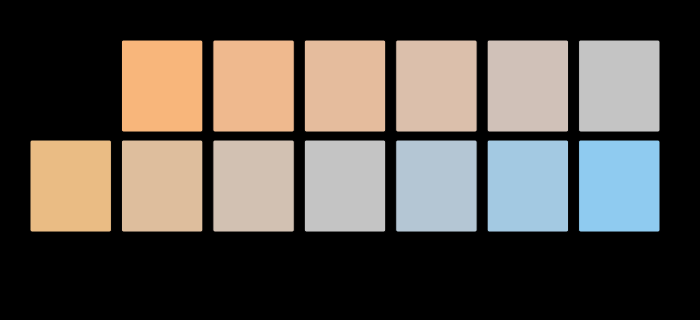
One white balance across a scene lit by two lamps. A neutral surface of albedo 0.6 under 7 mixtures of A and D65, corrected by one diagonal transform chosen for the middle of the run — which is what a camera does when it estimates a single illuminant. The middle patch comes out neutral to ΔE00 = 0.00 and both ends do not: 19.8 at the A end and 16.9 at the D65 one. The failure is structural rather than a matter of a better estimator: white balance is one transform for the whole image, and a scene with two lamps in it has no single answer for that transform to be. Every patch here is the same surface. What a scene does

A scene has no white point

White balance is one transform applied to a whole image, and a scene lit by two lamps has no single answer for that transform to be. The failure is structural rather than a matter of a better estimator — and every colour-managed workflow in existence takes exactly one white point as an input, with no field in which to say there were two.

A glossy surface returns two spectra, and only one of them is the paint. The dichromatic reflection model, computed rather than assumed. Light that enters a dielectric binder, scatters off pigment and comes back carries the reflectance — the body component, ΔE00 = 33.7 from the lamp. Light reflected at the interface never entered, so it carries the lamp's spectrum with only Fresnel's slight dispersion on it: ΔE00 = 1.14. The interface term is computed from Fresnel's equations on a Cauchy index at 45°, so its near-neutrality is a result here rather than an assumption. This is why a highlight is the one region of a photograph that tells a white balancer what the light was, and why removing highlights removes the evidence. What a scene does

Gloss changes the measurement

The same sample measured with the specular component included and excluded returns two different numbers, and both are correct answers to different questions. Colour is one of four appearance attributes and the only one most instruments report — so a specification that names a colour has silently named a geometry too, and usually does not say which.

A camera's spectral sensitivities, after the infrared-cut filter. Silicon quantum efficiency times the colour-filter dye times the infrared-cut filter, per channel, on a grid running to 1100 nm rather than to 780. With the filter removed, 68 per cent of the area under the three curves lies beyond the visible band, and all three curves are the same curve out there. What a camera does

A camera is a fourth observer

The 1931 functions, the 1964 functions and a person's own cones are three sets of three curves that collapse a spectrum onto three numbers. A camera is a fourth, built from silicon and dye rather than from pigment and neural wiring, and it agrees with none of them.

Everything between the photons and the picture, and what each stage decides. The 8 stages of a camera pipeline. Only the second is physics; every one after it is a decision somebody made, and the reason two cameras pointed at the same scene disagree is that they made different ones. What a camera does

Raw is not a picture

A raw file is three integrals per site and a list of decisions nobody has taken yet. Every one of those decisions has a defensible answer and none of them has a correct one, which is why two converters open the same file and disagree.

The blue channel, as the three things multiplied to make it. Silicon's quantum efficiency, the colour-filter dye's transmittance, and their product. The dye is the only stage carrying any colour information and it is clear above about 800 nm — transmittance 0.92 at 900 nm against 0.06 at 550. What a camera does

Silicon sees past the visible

A sensor's response ends at 1107 nanometres because that is the band gap, and the colour-filter dyes have stopped absorbing three hundred nanometres before it. So all three channels measure the same thing over the last third of the range, and every published sensitivity plot is drawn after the component that hides it.

How much of what an unfiltered sensor records is invisible. The share of a camera's raw signal coming from beyond 780 nm, against the colour temperature of the lamp, for one surface with a near-infrared reflectance of 0.62. Without the filter it runs from 98 per cent at 2000 K to 51 at 9000; with it, under five per cent everywhere. What a camera does

The filter that makes colour possible

An infrared-cut filter is not a refinement on a colour camera. Removing it collapses the separation between the three channels by a factor of nearly nine under tungsten, and the component that keeps colour photography working is the one nobody photographs.

One reflectance, four different infrared tails, and what the camera makes of each. The same visible reflectance continued past 780 nm to four different near-infrared values. A spectrophotometer reports only the left-hand part; an unfiltered sensor integrates all of it. The channel spread falls from 0.14 at a tail of 0.05 to 0.02 at 0.85, with nothing about the visible half changed. What a camera does

Most things are pale in the infrared

A spectrophotometer stops at 780 nanometres and a black cotton shirt reflecting five per cent of visible light reflects more than half the near infrared. The measurement everybody has and the quantity a camera integrates are different quantities, and nothing in the first says so.

A silicon sensor's best possible impersonation of the standard observer. The 1931 matching functions in outline, and the closest linear combination of the sensor's three sensitivities laid over them; underneath, what is left over at each wavelength. The residual is 31.7 per cent of the matching functions' own magnitude, worst at 440 nm. Colour reproduction is exact if and only if this is zero. What a camera does

Luther said when it would work

There is an exact condition under which a fixed three-by-three matrix converts camera raw to XYZ correctly for every spectrum in existence. It was stated in 1927, it is a theorem rather than a guideline, and no camera ever built satisfies it.
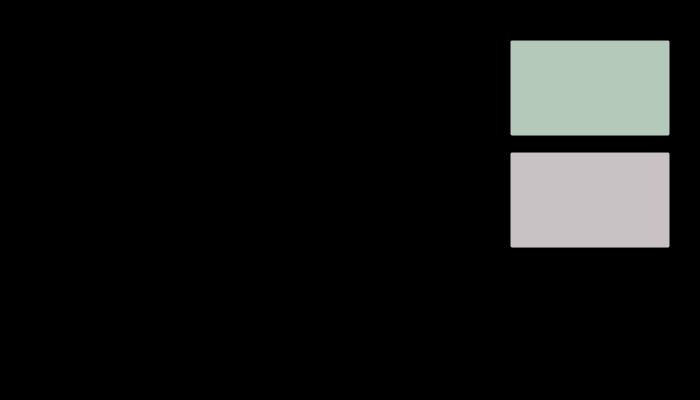
Two reflectances the camera records as identical. Constructed by projecting onto the null space of the sensor's own sensitivities, so the two raw triples agree to 0.0000 per cent. To the eye they are ΔE00 15.33 apart, which the swatches show. What a camera does

The camera has its own metamers

Two surfaces a camera records as identical can be plainly different to a person, and two a person cannot tell apart can be recorded as different. Both pairs are constructed rather than found, from one projection, used for both.

A camera profile is a fit, and the sample set is a hidden argument to it. Per-surface ΔE00 after the best 3 × 3 from raw to XYZ, fitted on 12 surfaces at chroma 0.2 and tested twice: on those same surfaces (mean 0.65) and on 12 at chroma 0.9 (mean 1.75). Both bars come from the same matrix; only the surfaces differ. What a camera does

A camera profile is a fit

Since no matrix is exact, the one a manufacturer ships is a least-squares compromise over a set of surfaces somebody chose. Fitted on desaturated patches it is excellent on desaturated patches — and the sample set is a hidden argument to every camera profile in existence.

The best a camera profile can do on the surfaces it was fitted to. Per-surface ΔE00 after the best 3 × 3 from raw to XYZ, fitted on 12 surfaces at chroma 0.7 and tested on those same 12 surfaces — mean 1.45, worst 2.58. This is the most favourable measurement it is possible to make of a camera and it is the one usually published. What a camera does

No matrix is right everywhere

The best three-by-three this sensor admits, fitted and tested on the same twenty-four surfaces, leaves a worst case of ΔE00 2.85. A control sensor built to satisfy Luther's condition reaches ten to the minus seven under the identical computation, which is what makes the first number a measurement.

A grey edge, reconstructed from a Bayer row, arrives coloured. Above: an achromatic step through 24 sensor sites, with green sampled on the even ones and red on the odd. Interpolating each channel separately reconstructs them from data taken on either side of the edge, so their ratio moves. Below: the resulting chroma, peaking at 144 per cent of the local mean, and 112 per cent once colour differences are interpolated instead. What a camera does

A grey edge arrives coloured

A sensor site measures one channel and the other two are interpolated from neighbours that sat somewhere else. Across a black-and-white step that reconstruction gives an achromatic scene a chroma of 144 per cent of its own local mean, and nothing in the scene or the sensor was coloured.

Recovering the lamp from a highlight rather than from an assumption. A green scene under illuminant A. The faint curve is the true lamp; the solid one is what the interface component of the glossy surfaces recovers, which is 0.30° from it. Grey-world on the same scene is 42.1° and max-RGB 17.5°, because both are assumptions about the surfaces and a Fresnel reflection is not. What a camera does

The highlight is the white balance

Every estimator a camera uses is an assumption about the scene wearing the costume of a measurement. The specular component of a glossy surface is not — it carries the illuminant to within a third of a degree on a scene where averaging is fifty times worse, and it does so without knowing what colour the paint underneath is.

Correcting colour costs noise, and the two cannot both be least. Sweeping the colour matrix from its own diagonal — a white balance with no cross terms — to the full least-squares fit. Mean ΔE00 falls from 18.61 to 1.29; photon noise rises by a factor of 1.03. At 10000 photons per pixel. What a camera does

Correcting colour costs noise

The matrix that turns a sensor's raw into XYZ has large off-diagonal terms of both signs, because that is what correcting a sensor which fails Luther's condition requires. Differences of large numbers are where noise grows, and the full correction amplifies photon noise by 1.66 times.

A clipped channel turns the hue of what is left. CIELAB hue shift against exposure for one saturated stimulus, measured against the same stimulus rendered without clipping. Nothing moves until the first channel reaches the ceiling at 0.25 stops; after that the recorded hue rotates by as much as 67 degrees, with nothing in the scene having changed colour. What a camera does

A blown highlight turns

An exposure that clips nothing changes no hue at all. Once one channel reaches the ceiling the recorded hue rotates by as much as sixty-seven degrees, with nothing in the scene having changed colour — and every response a converter can make to that is an invention.

A camera's spectral sensitivities, with the filter removed. Silicon quantum efficiency times the colour-filter dye times nothing else, per channel, on a grid running to 1100 nm rather than to 780. With the filter removed, 68 per cent of the area under the three curves lies beyond the visible band, and all three curves are the same curve out there. What a camera does

The grid outside every figure

Every figure here is computed on 380 to 780 nanometres, which is exactly right for an eye and insufficient for a sensor. This field met the first subject the grid cannot hold, and the decision was not to widen it — because widening it honestly is impossible.

Everything between the photons and the picture, and what each stage decides. The 8 stages of a camera pipeline. Only the second is physics; every one after it is a decision somebody made, and the reason two cameras pointed at the same scene disagree is that they made different ones. What a camera does

A photograph is not a measurement

A photograph is a measurement made by an instrument whose kernel nobody published, under an illuminant nobody recorded, corrected by a matrix fitted to somebody else's surfaces, with two thirds of every pixel invented. It supports relative claims well and absolute ones badly, and it is used for the second.
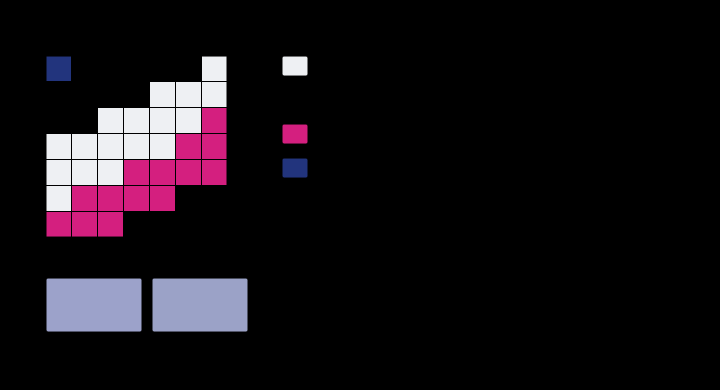
A halftone tint, its four regions, and what they average to. At 40% and 30% coverage the sheet is a mosaic of 4 fully-inked regions, not a mixture of anything. Their areas are the product of the coverages — Demichel's rule, which holds because the screens are rotated to make it hold — and the patch's reflectance is the area-weighted average of theirs, raised to the Yule–Nielsen exponent n = 1.8. Averaging the regions' CIELAB coordinates instead, which is what mixing means to almost everybody, lands ΔE00 = 0.76 away. What it takes to deliver it

A halftone is not a mixture

Forty per cent cyan and thirty per cent magenta are not stirred together anywhere. They are laid down as dots, and the sheet is a mosaic of four fully-inked regions in proportions the two coverages fix — which is why the colour is an area average of four spectra rather than a blend of two, and why it lands nowhere near where mixing would put it.

463 essays on this thread, page 3 of 20 · all threads · all essays