The collection

Every essay — page 19

Page 19 of 40, continuing through the fields in the same order.

What light is What the eye does Matching and measuring Difference and uniformity What the brain does What a scene does What a camera does Where the model breaks What it takes to deliver it

SeriesObserversNamed objectsRefutationsSearch

Where the model breaks

Seventeen observers in 1931, an error in the blue that was never fully repaired, colour vision deficiency, and the display this page is being read on.

A 8-bit ramp from 0.0008 to 0.006 of white, 12° wide. The top strip is the ramp as delivered: 16 distinct levels, each a step of one code value. Below it is the quantisation error as a Weber contrast against the local luminance, filtered by the luminance sensitivity function. The largest response is 8.51 per cent contrast against a threshold of 0.3, which is 28.4 times over — and it occurs at 0.09 per cent of white, at the dark end, because a code step is a Weber contrast and the same step is a larger fraction of less light.

Banding is not a bit depth

Eight bits bands at thirty times threshold in the shadows and at under three at mid grey, on the same ramp with the same encoding. What decides is where in the tone scale the gradient sits, how sharp each step's edge is, and how far away the reader is — and a bit count contains none of the three.

6 figures
The colourfulness the sRGB cube reaches, against the light in the room. The display is the same display throughout and the signal is the same signal. What moves is the adapting luminance, which enters the appearance model and nothing else. The furthest colourfulness the cube reaches falls from 131 to 57, a factor of 2.29. A gamut in CIELAB cannot show this at all, because CIELAB has no light level in it — which is why every gamut percentage in circulation is quoted without one.

The gamut shrinks in the dark

Every gamut number here is a property of a device and of nothing else, which is why the same display has the same gamut in a studio and in a cinema. It does not. Turn the room down four decades and the solid loses a fifth of its reach and two thirds of its volume, with the signal unchanged.

7 figures
How far a judgement is from the settled one, second by second. The light changed from one white to another at t = 0 and nothing else moved. The model has one degree of adaptation and no clock, so the distance plotted is what a clock adds: 3.6 CAM16-UCS units half a second in, still 1.3 after a minute, and 0.11 after five. Every appearance number on this site is the value at the right-hand end.

The model has no clock

An appearance model takes a stimulus and a situation and returns what it looks like. It does not take a time, and adaptation is not instantaneous — half a second after the light changes a judgement is three and a half CAM16-UCS units from the settled one, and a minute later it is still 1.3.

8 figures
How much colour a display delivers, against how bright the room is. The appearance solid of the whole code cube, with the room's reflected light added to every code value and the surround ratio computed from the room's own white against the display's. A 300 cd/m² panel delivers most at 200 lux, and the curve falls on both sides: darker costs the surround, brighter costs the black. At the 32 lux the softproofing standards specify, the solid is 89 per cent of its best — which is not a criticism of the standard, since it is written for matching a screen to a print viewing booth rather than for delivering the most colour.

A display in a room is a smaller display

Two results here turn the room's light in opposite directions and neither knows about the other. A room has one light level and does both at once — so there is a brightness at which a display delivers the most colour, it is not at either end, and it scales with the panel.
6 figures
One light, two eyes. The same stimulus through two sets of ocular media differing only in macular pigment (0.35 and 0.41) and lens age (55 and 55 years). Compared under one white the two differ by ΔE00 1.00; compared with each eye adapted to its own long-run white — which is what the visual system does — by 0.00. The second number is why nobody notices, and the first is why a person who has had one lens replaced reports that the other eye has turned yellow.

Nobody here has two eyes

One person's two eyes differ in macular pigment and lens density, so the same light produces two colours — a whole ΔE00 apart for an ordinary pair, seven for one replaced lens. Adaptation hides it exactly, which is why nobody notices and why nothing in colorimetry has a term for it.

8 figures
What a dither mask is worth, read as components, in two dimensions. Five luminance ramps, each quantised to 8 bits with and without a high-passed mask of the same power. The bars are the most visible single sinusoidal component of the error, as a multiple of the contrast that component needs to be seen: above the line at one it is visible. The mask lowers it by 20–22×, on every ramp — which the one-dimensional model on this site says it does not, and that disagreement is the finding.

Every threshold was measured with a grating

An earlier essay here claimed that the model cannot explain why dither works, and named two missing pieces. One of them was real and worth thirteen times the guess; the other was not needed. The piece nobody named was the detector — and reading the same model two ways changes the answer by a factor of fifty.

5 figures
Every filtered claim in these essays, read at a point and read as components. Each row is a comparison one of the essays makes. The bar is the ratio between the two readings — how many times larger the component answer is than the point answer, or the reverse — on a logarithmic scale. 5 of 7 disagree by more than half again, and 4 disagree about the direction of the effect rather than merely its size. The three marked as noisy are the ones with a noise field on one side of the comparison, and they are the three largest.

The list nobody made

The last phase found that reading a filtered signal at a point asks a question its thresholds were never fitted to, made it a standing rule, and admitted that nobody had gone back through the site to see which claims it touched. Here is the list. Every claim with noise on one side of it moves — and so do two that have no noise in them at all, which the rule said would not.
4 figures
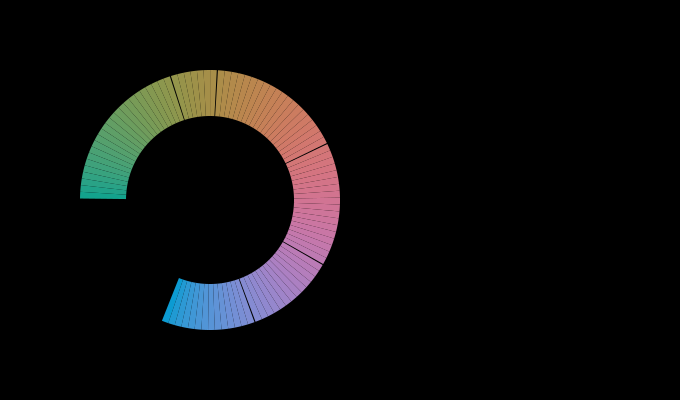
The hue circle cut into names, at L 60 and C 40. Left, the arcs each name claims, drawn at the colour of their midpoints; right, the same arcs measured in ΔE00 by integrating the difference along the ring rather than in degrees. The widest is 5.3 times the narrowest in degrees and 4.5 times in colour difference, so the metric accounts for 15 per cent of the inequality and no more. Only the eight chromatic terms compete on this ring: at this chroma the achromatic three would otherwise take the region where no basic English term sits, which is a defect of the model and is named in the essay.

There is no word for that colour

The naming model built this phase gives a saturated cyan the name green, calls part of a chromatic ring grey, and puts one of the eleven focal colours outside what a display can show. Each failure is a measurement rather than a disclaimer, and together they say what a vocabulary is that eleven points and a distance are not.

8 figures
Every claim here that was computed with one model, recomputed with two. Each row is a claim one of these essays makes. The bar is how many times the two-model answer differs from the one-model answer, on a logarithmic scale. 3 of 13 have no bar at all: the first model's answer for them is exactly zero, not because it computed zero but because it has no variable for the quantity. Those are the rows where a second model did not correct an answer — it supplied one.

What a second model changed

Thirteen claims here, each computed with one model and recomputed with two. Ten of them move by half again or more. Three of them do not move at all in the ordinary sense — the first model's answer is exactly zero, not because it computed zero but because it has no variable for the quantity — and every one of those three is a join that supplied a state or a device rather than a spread.

5 figures
Every change of light this site models, and how much of it a gain removes. Each row is a change of illumination. The pale bar is how far it moves an ordinary surface for an observer who does not adapt; the solid bar at its left end is what is left after the observer has applied the one gain adaptation gives them, which is the ratio of the two whites in the CAT16 basis and is not fitted to anything. Sorted by the fraction left rather than by the size of the change, because the two orderings are different: the largest change here is removed almost entirely and the worst row is a change less than a third its size.

What no adaptation can remove

A change of light is exactly a 3×3 matrix on tristimulus values, and adaptation is a diagonal one. Putting every change of illumination this site models through that distinction sorts them by how much of themselves they leave behind, and the smallest residual in the census belongs to a filter inside the eye.

7 figures
Four devices, and what each of them can do about a change of light. The mean over the census of what each device is left with. A press has no mechanism, so its number is the whole change — a printed sheet does not adapt to the room it is read in. A display can move its white point, which is a gain in its own primaries. A camera applies a gain in whatever basis its filter dyes happen to give it. And the sensor that satisfies the Luther condition exactly is worse than the silicon one — satisfying the condition means its channels are the matching functions, and a per-channel gain on the matching functions is the transform this site calls the oldest mistake still shipping.

Only one of these devices adapts

An eye, a camera, a display and a press all meet the same changes of light, and each has at most one thing it can do about them. The press has nothing at all, so its column is the whole change; and this collection's sensor built to satisfy the Luther condition exactly is the one that adapts worst.

7 figures
Outside the set of colours a reflecting surface can be. How far each stock sits from the boundary of the object-colour solid, as a fraction of the bound. The line at zero is the boundary: a perfect diffuser sits exactly on it, and every reflectance ever made sits to its left. The pale marker is the sheet measured with the ultraviolet excluded and the dark one with it included. Two of the six cross the line — they are brighter, in a direction that can be written down, than any reflecting surface of their colour could be. This is a proof rather than a hull: for each sample a direction is found in which the largest value any reflectance can reach is computed exactly, and the sample exceeds it.

A white that is not a reflectance

The object-colour solid is the hardest boundary in colorimetry — the set of tristimulus values any reflecting surface can produce, with no assumption about pigments in it at all. A coated press stock under a measurement standard's own lamp sits 1.5 per cent outside it, and a heavily brightened one 4.0, and with the ultraviolet removed both come back inside.

6 figures