The collection

Every essay — page 36

Page 36 of 40, continuing through the fields in the same order.

What light is What the eye does Matching and measuring Difference and uniformity What the brain does What a scene does What a camera does Where the model breaks What it takes to deliver it

SeriesObserversNamed objectsRefutationsSearch

What it takes to deliver it

A colour that stays where it was measured is nobody's problem. This is the apparatus that carries one to somebody else — ink on a sheet, a profile, a rendering intent, a proof, and a room — and every stage of it is a map that loses something, chosen deliberately.

How wrong a profile is between its entries. A device profile is a lattice of measured patches and an interpolation. At every node of every grid drawn here the error is exactly zero, which is why a profile checked at its own patches always looks perfect. Sampled between the nodes, a 3-step grid is worst by ΔE00 = 2.93 and a 17-step grid by 0.30. Both are honest tables of the same press.

A profile is a table

An ICC profile does not contain a model of the device it describes. It contains a lattice of patches that were printed and measured, and everything between them is interpolation — which is exactly zero at every patch, so a profile checked against its own target reports perfection for ever.

7 figures
The process inks as reflectance. Each ink is a sum of Gaussian absorbance bands with stated centres, widths and peak densities, and the reflectance shown is the substrate's times the square of the ink's transmittance, because light crosses the film going down and coming back. The first band of each ink is what it is for; the rest are what is wrong with it. Magenta's unwanted absorption in the blue-violet reaches an optical density of 0.46 against 0.95 for the band it exists to have — 48 per cent of its own strength, absorbing exactly where a saturated blue needs light to survive.

The paper is the white point

A printed colour is reported against the sheet it sits on rather than against the light in the room, and the choice is a switch in every colour engine. Flipped one way, the same separation on coated stock and on newsprint is a 3.04 colour difference; flipped the other, it is 0.13 — and the two answers are about different questions.

7 figures
The solids, by volume. CIELAB volume, all measured by the same cell count with the same extrapolation, and quoted against sRGB because that is the comparison the estimator supports. The four-colour press reaches 49 per cent of the sRGB solid's volume — and contains colours sRGB does not, which is why "half the gamut" is the wrong summary of a ratio of one half.

The fourth ink is not for colour

Black is in every process set and it extends the gamut by more than a third — and at every lightness above about forty it extends the chroma boundary by exactly nothing. What it buys is depth at the bottom, a neutral that holds its hue when the press drifts, and a way to put a full-strength dark on a sheet that could not carry three inks' worth of it.

6 figures
What happens to a tone the destination cannot print. Source lightness along the bottom, destination lightness up the side, for a print whose black is L* = 8. Clipping is the flat segment on the left — 4 of 10 levels in the bottom twenty points of the scale arrive as the same number, and nothing downstream can recover them. Black point compensation is the straight line: all 10 levels survive as different numbers, and every tone in the picture has moved to pay for it.

A black that is not black

The deepest colour a four-colour press can make is L* 2.4, and against its own paper that is a contrast of about 320 to 1 — less than a cheap display manages in a dark room. Everything a printed picture does in the shadows is done inside that range, and the two ways of fitting a picture into it destroy different things.
5 figures
What separates the separations, and under which light. 11 separations of a single colour, differing only in how much of it is carried by black rather than by the three chromatic inks. Under D50 they agree to ΔE00 = 0.00 — the solver was asked for that and delivered it. Under illuminant A they spread to 6.75. They are metamers of one another, and the whole family is invisible to any instrument reading a single illuminant.

The separation is not unique

A four-ink press has one more control than a colour has numbers, so most colours can be printed several ways. The alternatives agree to a hundredth of a colour difference under the light the match was made in — and they are metamers of one another, so under a tungsten lamp the same eleven separations of one colour spread by nearly seven.
6 figures
A gradient of one hue, mapped into a press's gamut 2 ways. Chroma asked for along the bottom, chroma delivered up the side, for a ramp at lightness 55 and hue angle 25°. A colorimetric intent follows the diagonal until the press runs out and is flat afterwards — the flat part is a gradient arriving as a single colour. The perceptual intent is under the diagonal from the start, which is the price of never going flat.

No mapping preserves everything

More than half the sRGB solid is outside a press's gamut, so something has to be done with it, and there are two things that can be done. One leaves every reproducible colour exactly where it was and delivers a gradient as a flat area. The other keeps the gradient and moves every colour that needed no help by about three.

6 figures
What separates the separations, and under which light. 11 separations of a single colour, differing only in how much of it is carried by black rather than by the three chromatic inks. Under D50 they agree to ΔE00 = 0.00 — the solver was asked for that and delivered it. Under illuminant A they spread to 6.75. They are metamers of one another, and the whole family is invisible to any instrument reading a single illuminant.

The lamp in the shop decides

Two packages printed to the same specification, verified under the same standard illuminant and passed, can differ by nearly seven colour differences on a shelf under a tungsten lamp. Nothing went wrong at either press. The specification named one light, the separations that satisfy it are metamers of one another, and the shop chose the second light.
9 figures
A named ink, and the closest four-colour build of it. The ink is one pigment chosen for its own spectrum; the four-colour build is three chosen for everything. The four-colour build reaches it to ΔE00 = 0.37 under D50 and drifts to 4.46 under a tungsten lamp, because the match is metameric — the two curves cross 4 times rather than coinciding anywhere.

A brand colour is an ink

A named colour is a jar of pigment with a spectrum, and a four-colour build of it is three inks arranged to integrate to the same three numbers. Of 156 constructed single-pigment inks, 15 can be matched at all — and those fifteen drift by a median of 3.8 colour differences under a tungsten lamp, because the match was never a match.

9 figures
The solids, by volume. CIELAB volume, all measured by the same cell count with the same extrapolation, and quoted against sRGB because that is the comparison the estimator supports. The four-colour press reaches 49 per cent of the sRGB solid's volume — and contains colours sRGB does not, which is why "half the gamut" is the wrong summary of a ratio of one half.

The fifth ink buys a corner

Orange, green and violet are sold as the answer to a four-colour press's gamut, and each one adds seven to nine per cent of volume. All three together add 23 per cent — almost exactly the sum, with no interaction — and every bit of it lands in the region of the ink that was added, at lightnesses where that ink is dark.
6 figures
Lightness against colourfulness, in a booth and on a screen. Each arrow is one colour, from what the model predicts under a print in a 2000 lux booth to what it predicts under a display in a dim room. Every arrow points the same way, which is the content: a dimmer surround lowers predicted lightness and colourfulness together, so a proof does not merely differ from the print, it differs in a direction — and that is why proofing standards specify the room and not only the numbers.

The proof is a different object

A soft proof can be made colorimetrically exact and still not match the print, because the print is in a booth at two thousand lux with an average surround and the screen is in a dim room at a fifth of the luminance. The appearance model puts four CAM16-UCS units between them, with no change of stimulus anywhere — larger than the error any rendering intent is arguing about.

7 figures
The tone scale of one display, in four rooms. Code value along the bottom, the lightness it comes out at up the side. The curves are the same display: what changes is the light falling on the screen, which adds a fixed luminance to every pixel. The signal value that means black arrives at L* = 11.7 at 600 lux, against 0.9 in the dark — the lightness of a dark grey card, from a pixel that is switched off.

The screen is not the room

A thousand-to-one display in an ordinary office is a hundred-and-thirty-seven-to-one display, and the signal value that means black comes out at the lightness of a dark grey card. Nothing is wrong with the panel. Light falls on the screen and comes back off it, and the two per cent it returns is added to every pixel — most of all to the ones with nothing else in them.
6 figures
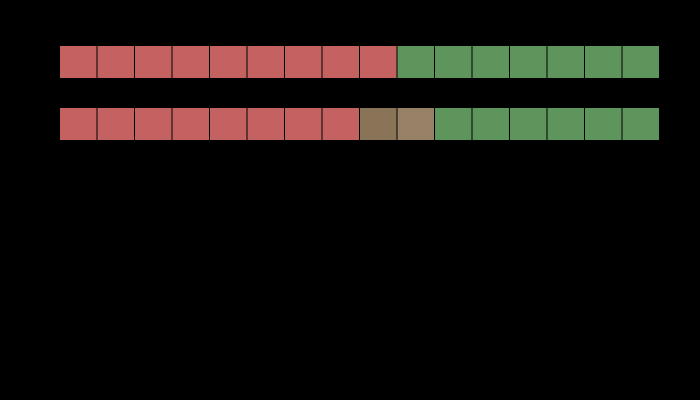
An edge at 4:2:2, and the colour it arrives as. Above, the row as it was sent and as it arrives after the two chroma planes are averaged 2 samples at a time. Below, the colour difference at each sample. The worst is ΔE00 = 25.88, at a luma step of 0.058 across the edge — an edge of nearly equal luminance. Nothing is wrong with the codec: it discards the differences the eye resolves worst, and this edge is made of nothing else.

Colour thrown away on purpose

Every video format in use discards three quarters of its colour information and keeps all of its luminance, because the eye resolves fine colour detail badly. On an edge that carries luminance the loss is exactly zero. On an edge of nearly equal luminance it is a colour difference of forty-three, and the two edges are the same edge to the codec.

7 figures