The eleven basic colour terms, at their quoted centroids
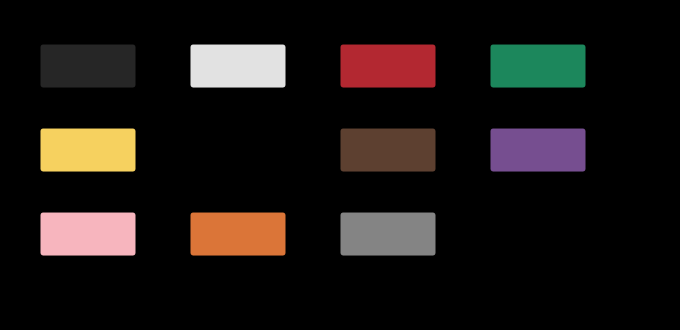
Drawn at its defaults, in the names colours have. It takes no options at all, so every essay calling it gets this exact drawing.
Called by 8 essays
the blast radius of changing it
A colour has a name
Every quantity here is a number, and the question a reader arrives with is what colour something is called. The eleven basic terms of English divide the space into territories that differ by a factor of five, the metric accounts for fifteen per cent of that, and one of the eleven focal colours cannot be shown on this page at all.
What the brain doesA name is not a threshold
Two colours have to move about ten times a just-noticeable difference apart before people stop calling them the same thing, and how far varies threefold across one plane of the space. A tolerance and a word are answering different questions, and nothing in colorimetry converts between them.
Matching and measuringA catalogue is not a vocabulary
A colour order system is a regular lattice, because a person has to be able to find a page. Sorted by what its chips would be called, that lattice comes apart into piles differing by a factor of three — and a fifth of all one-step moves in it change the name.
Where the model breaksThere is no word for that colour
The naming model built this phase gives a saturated cyan the name green, calls part of a chromatic ring grey, and puts one of the eleven focal colours outside what a display can show. Each failure is a measurement rather than a disclaimer, and together they say what a vocabulary is that eleven points and a distance are not.
What the brain doesA name moves with the room
Eleven basic colour terms are quoted as centroids in CIELAB and a colour is named by which one it is nearest. Two things nobody records decide the answer — which distance function is used, which renames a fifth of the displayable gamut, and which room the colour is in, which renames more than a quarter of it.
What the brain doesA name in the model's own words
The eleven basic colour terms move when the room does, and the obvious objection is that they were being measured in a space with no room in it. Quoting them in an appearance model's own coordinates instead does not shrink the renaming — it grows it by four per cent — and the space alone renames an eighth of the gamut with the room held still.
What the brain doesThe hue scale has four corners
CIECAM16 reports hue twice — as an angle in its own opponent plane, and as a quadrature interpolated through four unique hues with four fitted weights. The second is the one hue tolerances and hue-preserving mappings are written in, and it is piecewise — its slope jumps at each of the four anchors, by a factor of 1.74 at green and by 0.41 at blue, and it runs 4.1 times faster near yellow than near blue.
What the brain doesA name moves with the reader
Three earlier essays have moved a colour's name by changing the distance function, the room and the space. All three held the observer fixed. Handed the same light from the same display, sixty observers rename between 3.5 and 13.1 per cent of the gamut against the standard observer, a quarter of its colours have a dissenter in twenty, and the narrower the display's primaries the worse it gets.